Home › Wine Notes › Veuve Clicquot Ponsardin (LVMH)
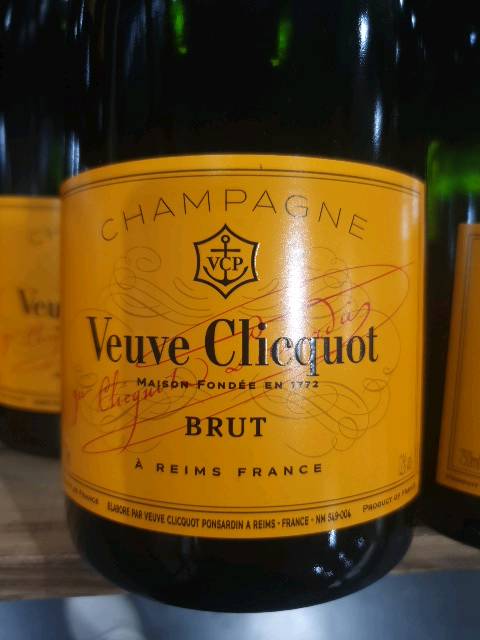
Veuve Clicquot Brut Yellow Label (Carte Jaune) NV
SparklingFranceNV
By Daniel Min · Tasted 2019-11-13 · Published 2026-09-09 · Updated 2026-09-09
At a glance
James Suckling 92 · Wine Spectator 91 · Decanter 91 · Tasting Panel 93 · critics listed on Vivino 85–94 (1993–2021, by release) · CSWWC 2022 Gold
Market note: Alongside Moët & Chandon Impérial, one of the best-selling non-vintage Champagnes in the world, and the bulk of Veuve Clicquot's output. With its high Pinot Noir share it is generally described as more structured than Moët, with pronounced bread and apple. Cellar master since 2019: Didier Mariotti.
What this wine is
Veuve is French for 'widow'. The house founded in Reims in 1772 by textile merchant Philippe Clicquot passed, when his son François died suddenly at thirty in 1805, to a 27-year-old daughter-in-law, Barbe-Nicole Ponsardin. Under pressure to wind up a company with no male heir, she instead put her own name on it — Veuve Clicquot Ponsardin — and in 1814, the moment the Napoleonic Wars ended, pushed 10,550 bottles into Russia ahead of every competitor and won over the court at St Petersburg. In 1816 she devised the riddling table (remuage): bottles set at an angle and turned a little at a time so the sediment collects in the neck. It is how cloudy Champagne became clear, and every house still uses it. The yellow label was added in 1876 to tell the British market this was a dry Champagne, and in 1877 the colour itself was trademarked. LVMH has owned the house since 1987.
Yellow Label is the face of the house and most of what it makes. It blends 50–55% Pinot Noir, 28–33% Chardonnay and 15–20% Meunier from 50–60 crus. To that go 25–45% reserve wines aged up to 30 years, so that every year tastes the same — the reserve wines are the whole point of a non-vintage Champagne. About three years on the lees, a dosage (added sugar) of 9–10 g/L, 12% alcohol. The house sums up the wine as 'freshness, strength, aromatic richness and silkiness', with Pinot Noir giving structure, Chardonnay elegance and Meunier roundness.
What the world says
James Suckling 92 — "Firm and delicious, showing sliced apples and green pears with some flint and bread dough." Wine Spectator 91 — "Refreshing aperitif style with notes of patisserie apple, pear, lemon parfait and chopped almond." Decanter 91 — "Fresh croissants, red berries, green apple and lively lemon citrus, with lovely creaminess to the bright finish." The critics listed on Vivino range from 85 to 94 across releases from 1993 to 2021 — which is to say, a non-vintage Champagne varies a little from bottle to bottle.
The Vivino community: 149,289 ratings, average 4.3 — by far the most-rated wine in this magazine. 87% at 4 or above, 23% at 5. Keywords: apple, green apple and pear (6,241 mentions), citrus and lemon (4,503), toast, brioche, biscuit and almond (3,861), then yeast and cream, minerals and honey. Acidity 4.3/5, fizziness 4.3, intensity 3.8. Apple and bread. 150,000 people use the same two words.
"Star of the show! Neutral, pure, almost unreal — enjoyable and decent at the same time. Great, but needs some minutes to open." — Vivino review, May 2017, 4.5 stars
"With nearly 120,000 reviews here on Vivino, you can definitely call this Champagne a classic. A blend of 50–55% Pinot Noir, 28–33% Chardonnay and 15–20% Meunier. Antique gold." — Vivino review, Aug 2022, 4.3 stars
"Crystal light yellow with delicate bubbles. Green apple and pear with brioche and oyster minerality. Full-bodied and high in acidity, but a classic." — Vivino review, Dec 2022, 4.3 stars
How I drank it
November 13, 2019, 4.5 stars. "When I eat great champagne."
The note is not a sentence, it is a situation. Reading it now I am honestly not sure what I meant — probably 'the bottle you pick when you need a proper Champagne'. It was week three of logging and the day I uploaded fifteen backlogged bottles at once, so there was no time to polish. The same day I gave the Charles Dauteuil Blanc de Blancs 4.5, the Canti Prosecco 4 and the Ruhlmann crémant rosé 3. And six days earlier, on November 7, I had given Dom Pérignon 2008 my first 5 since I started keeping score.
That half-star gap between the Dom Pérignon and this bottle is where my Champagne scale begins. Dom Pérignon is a vintage Champagne, one year's grapes aged close to a decade in bottle; Yellow Label is a non-vintage that blends dozens of villages and reserve wines to taste the same every year. One is drinking a year; the other is drinking a house style. The me of 2019 had no words for that difference but scored it anyway. Yellow Label smells honestly of apple and toasted bread, and with that much Pinot Noir you feel the weight when you lift the glass. There is no arguing with 150,000 people at 4.3.
If I drink it again I would change one thing. At ₩90,000–120,000 (about US$65–87) the Korean price is close to double the US$60–75 abroad, and that money also buys a small grower's Grand Cru Champagne — which is exactly what the Charles Dauteuil was that night, at the same score. Yellow Label is still the safest gift in the world, but when it is my own money and my own glass, I reach for it less unless a hypermarket is running its year-end sale. And since I gave the same house's La Grande Dame 4.5 in May 2024, it seems my ceiling for Veuve Clicquot is fixed right where it was.
Vivino community data
NV vintage rating distribution (149289 ratings, average 4.3)
| 5★ | 34534 (23%) | |
| 4★ | 94699 (63%) | |
| 3★ | 17333 (12%) | |
| 2★ | 1745 (1%) | |
| 1★ | 978 (1%) |
Most-mentioned aromas
| Family | Mentions | Top keywords |
|---|---|---|
| Tree fruit | 6241 | apple 1885 · green apple 1673 · pear 1645 · peach 393 · apricot 214 |
| Citrus | 4503 | citrus 2366 · lemon 1120 · lime 338 · grapefruit 259 |
| Bread & nuts (non-oak) | 3861 | toast 1383 · brioche 1324 · biscuit 451 · almond 296 |
| Yeast & dairy | 1742 | yeast 783 · cream 650 · cheese 121 |
| Earth & minerals | 1394 | minerals 551 · honey 389 · stone 143 · chalk 47 |
| Oak | 965 | butter 385 · vanilla 256 · oak 99 · caramel 88 |
| Vegetal | 352 | straw 218 · grass 41 · hay 39 |
Structure: Acidity 4.3/5 · Fizziness 4.3/5 · Intensity 3.8/5
Average by vintage (all vintages: 149289 ratings, average 4.3)
| Vintage | Average | Ratings |
|---|---|---|
| NV | 4.3 | 149289 |
My original note (Vivino, 2019-11-13)
“When i eat great champagne.”
Buying in Korea
Frequently asked questions
What kind of Champagne is Veuve Clicquot Yellow Label?
The flagship non-vintage Brut of Veuve Clicquot, founded in Reims in 1772 and now part of LVMH. It blends 50–55% Pinot Noir, 28–33% Chardonnay and 15–20% Meunier from 50–60 crus with 25–45% reserve wines aged up to 30 years, then rests around three years on the lees. Dosage 9–10 g/L, 12% alcohol. A structured style of apple, pear, brioche and toast; James Suckling 92, Vivino 4.3 from 150,000 ratings.
How much does it cost?
Korean retail ₩93,000–121,000 (Vinobot, August 2026, about US$67–88). Reports of buying it in the ₩60,000–70,000s (about US$43–51) at Costco and E-mart year-end promotions are common. Overseas retail is US$60–75 (UK £58), so the Korean list price is close to double. The importer is Moët Hennessy Korea.
What food does it go with?
Vivino lists pork, shellfish, rich fish such as salmon and tuna, and mild soft cheese. With its high Pinot Noir share it carries more weight than a blanc de blancs, so it suits fried chicken, jeon (Korean savoury pancakes), oysters and sushi. Serve cold at 8–10°C and give it a few minutes in the glass to open.
Who was Madame Clicquot, and what is riddling?
Barbe-Nicole Ponsardin (1777–1866) took over the company at 27 when her husband François Clicquot died in 1805, and built it under the name 'Veuve (Widow) Clicquot'. In 1816 she devised the riddling table (remuage): bottles set at an angle and turned a little each day so the yeast sediment gathers in the neck, which made clear Champagne possible at scale. Every Champagne house still uses the method.