Home › Wine Notes › Argiano
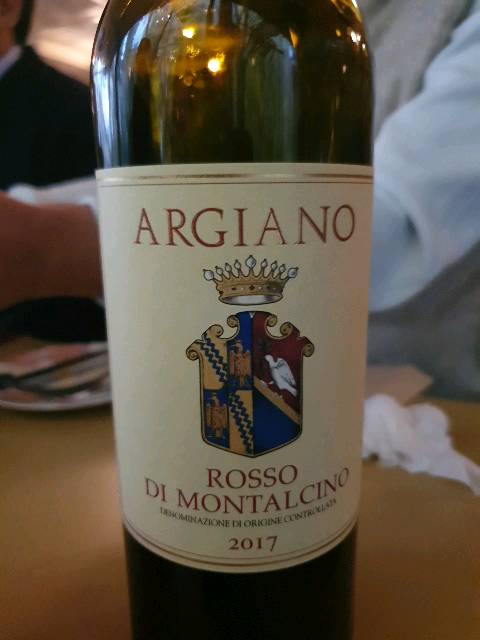
Argiano Rosso di Montalcino 2017
RedItaly2017
By Daniel Min · Tasted 2019-11-15 · Published 2026-09-09 · Updated 2026-09-09
At a glance
James Suckling 91 — "fragrant… reminiscent of a Pinot, with roasted herbs, cedar, rose petals" · Wine Enthusiast 90 — "a smooth, approachable palate offers fleshy Morello cherry" · a critic listed on Vivino 88 (Jan 2019) · Vivino community 3.8 (353 ratings)
Market note: The Brunello off the same slopes runs US$90–120; the Rosso is US$25–30. Prices for the Rosso rose after the Brunello 2018 took Wine Spectator's Wine of the Year in 2023. On Vivino the vintage averages step up a notch from 2019 (4.0) onward.
What this wine is
Montalcino is a hill town south of Siena in Tuscany, and Argiano sits at its south-western edge, above the hamlet of Sant'Angelo in Colle. The heart of the place is a Renaissance villa — Villa Bell'Aria — built in 1580 by the Pecci family, with cellars cut in beneath it. The vineyards cover 57 hectares at 270–320 m of elevation. The Tyrrhenian Sea is 50 km away, so sea breezes come through, and limestone in the soils holds on to Sangiovese's acidity.
Today's Argiano is explained by two names: André Esteves, the Brazilian financier who bought the estate in 2013, and Bernardino Sani, CEO and winemaker since 2012. Sani abandoned the extracted, powerful style of the 1990s, replaced new barriques with large French and Slavonian casks of 1,000–5,000 litres, mapped the soils parcel by parcel and completed EU organic certification in 2018. The result of that direction is the Brunello di Montalcino 2018 — the wine Wine Spectator scored 95 and named its Wine of the Year for 2023.
Rosso di Montalcino is the younger sibling of the house. Same town, same grape (100% Sangiovese), different rulebook. The Rosso DOC, created in 1983, can be released after a minimum of one year's ageing with no oak requirement; Brunello DOCG has to serve five years, including two in oak and four months in bottle. Which is why the Rosso costs US$25–30, a third of the Brunello, and is made to be drunk young. The producer describes it as "deep ruby, medium-bodied, red fruit, violets, menthol and earth, with smooth, velvety tannins." Alcohol is given as 14% or 14.5% depending on the source.
What the world says
2017 was a record year in Montalcino, and not in a good way. Summer weather arrived by mid-May and close to five and a half months passed without rain. April frost cost the lower vineyards 5–15% of the crop, and Brunello production fell roughly 20% against 2016. Smaller berries meant more concentration, but alcohol climbed with it: more than 20% of the 2017 Brunellos critics tasted came in at 15% or above. The consensus is that balance varied enormously by producer. Argiano, with its elevation and its sea breeze, ended up on the fortunate side.
James Suckling gave the 2017 Rosso 91 points: "fragrant… reminiscent of a Pinot, with roasted herbs, cedar, rose petals." Wine Enthusiast gave it 90 — "a smooth, approachable palate offers fleshy Morello cherry." For a scorching vintage, both reviews reach for 'fragrant' and 'smooth' rather than 'heavy'.
The Vivino community of 353 averages 3.8, with 59% at 4 or above. The largest keyword group by far is red fruit (420 mentions: cherry 157, strawberry 56, raspberry 33), then earth and leather (265) and oak (246). On structure, acidity scores 3.3/5 — higher than intensity (3.1) or tannin (3.0). Acidity, in other words, is the axis of this wine. Vintage averages sat at 3.6–3.8 from 2005 onward and then step up clearly from 2019 (4.0, 1,262 ratings), the point at which Sani's changes reach the bottle.
"A magnificent Tuscan red. Crisp, light tannins with strawberry and cherry. Nice acid balance and great on the nose." — Vivino review, Feb 2020, 4 stars
"A very approachable Sangiovese — soft tannins, unusual for a young Sangiovese. The fruit is in the savoury cherry-pip spectrum with a touch of red cherry sweetness and spice. Long, lingering finish with fine acid." — Vivino review, Feb 2021, 4 stars
"High acidity — it brings out the taste. Adequate tannin, medium body, cherry. I can find tons of food to go well with this. A perfect table wine, though it is probably a bit luxurious to call it one." — Vivino review, Oct 2019, 4 stars
How I drank it
November 15, 2019, 4 stars. "Cherry, strawberry, plum. This wine has a good acidity."
This entry means something to me. Two days earlier, on November 13, I logged sixteen bottles in a single day — Almaviva 4.5, Juan Gil 3, Mouton Cadet 3, Tarapacá 3.5 — and most of those notes were one word: "not bad", "good", "typical merlot". Two days after the storm passed, the bottle I opened on my own was this Rosso, and here for the first time I wrote down three aromas. It is my first Sangiovese, and the first Italian red I gave a proper tasting note.
The fun part is lining that up with the data now. I wrote cherry, strawberry and plum; the words those 353 Vivino members use most are exactly cherry (157) and strawberry (56), with plum at 21 in the black-fruit group. The thing I called "good acidity" is the very trait that comes out top of the community's structure scores at 3.3, above tannin and intensity. With almost no wine knowledge, my nose got there first. That is why I keep re-reading these old entries for this magazine.
My score was 4, two-tenths above the community's 3.8. Three days before, on November 12, I had given Villa Antinori Rosso 2016 a 4.5 and written "perfect scent and balance, like a Burgundy Pinot Noir" — so my palate was already leaning towards Tuscan red fruit and acidity. The same direction Suckling was pointing when he said the 2017 Rosso reminded him of a Pinot.
If I drink it again, the rules are simple: do not treat it as a grand bottle. It needs none of the Brunello's hours of air. Open it, serve it at 16–18°C with a tomato-sauce pasta, plainly grilled beef, or cured meat like prosciutto, and that is enough. The suggested window for the 2017 is 2020–2027, so we are in its last stretch, and this vintage is essentially gone from the Korean market anyway. What is here instead are the 2019–2021 vintages that stepped up to 4.0, at ₩47,000–60,000 (about US$34–43). And wondering about the Brunello from the same slopes is simply what happens next to anyone who drinks the Rosso.
Vivino community data
2017 vintage rating distribution (353 ratings, average 3.8)
| 5★ | 31 (9%) | |
| 4★ | 178 (50%) | |
| 3★ | 131 (37%) | |
| 2★ | 9 (3%) | |
| 1★ | 4 (1%) |
Most-mentioned aromas
| Family | Mentions | Top keywords |
|---|---|---|
| Red fruit | 420 | cherry 157 · red fruit 95 · strawberry 56 · red cherry 36 · raspberry 33 |
| Earth & leather | 265 | earthy 103 · leather 93 · smoke 15 · minerals 9 · forest floor 8 |
| Oak | 246 | oak 97 · vanilla 45 · tobacco 29 · chocolate 20 · cedar 12 |
| Black fruit | 77 | blackberry 24 · plum 21 · black cherry 7 · dark fruit 5 · blackcurrant 4 |
| Spice | 63 | pepper 16 · licorice 11 · cinnamon 7 · menthol 6 · dried herbs 5 |
| Vegetal | 23 | tomato 19 · rhubarb 2 · grass 1 · tomato leaf 1 |
| Floral | 17 | violet 11 · rose petal 2 · dried rose 1 · geranium 1 · lavender 1 |
Structure: Acidity 3.3/5 · Intensity 3.1/5 · Tannin 3.0/5 · Sweetness 1.5/5
Average by vintage (all vintages: 9137 ratings, average 3.8)
| Vintage | Average | Ratings |
|---|---|---|
| 2005 | 3.7 | 45 |
| 2006 | 3.7 | 70 |
| 2007 | 3.7 | 54 |
| 2008 | 3.8 | 181 |
| 2009 | 3.7 | 224 |
| 2010 | 3.6 | 277 |
| 2011 | 3.8 | 536 |
| 2012 | 3.8 | 454 |
| 2013 | 3.8 | 429 |
| 2014 | 3.6 | 529 |
| 2015 | 3.8 | 724 |
| 2016 | 3.8 | 692 |
| 2017 | 3.8 | 353 |
| 2018 | 3.8 | 694 |
| 2019 | 4.0 | 1262 |
| 2020 | 4.0 | 544 |
| 2021 | 4.0 | 357 |
| 2022 | 3.9 | 550 |
| 2023 | 3.9 | 466 |
| 2024 | 4.0 | 159 |
My original note (Vivino, 2019-11-15)
“Cherry, strawberry, plum. This wine has a good acidity.”
Buying in Korea
Frequently asked questions
What kind of wine is Argiano Rosso di Montalcino?
A 100% Sangiovese red from Argiano, at Sant'Angelo in Colle in south-western Montalcino, Tuscany. Same vineyards and same grape as the estate's Brunello, but with far shorter ageing requirements, so it is made to drink young. 14–14.5% alcohol, medium-bodied, built on acidity, with cherry, strawberry, violet and earth. James Suckling 91, Wine Enthusiast 90, Vivino 3.8 from 353 ratings.
What is the difference between Rosso di Montalcino and Brunello?
Both are 100% Sangiovese from the same Montalcino zone. The difference is the ageing rules. The Rosso DOC, created in 1983, can be released after a minimum of one year with no oak requirement; Brunello DOCG must serve five years, including two in oak and four months in bottle. That is why the Rosso costs about a third of the Brunello and drinks much earlier — hence the nickname 'baby Brunello'.
How much does it cost?
Korean retail ₩47,000–60,000 (Vinobot, August 2026, about US$34–43, for the 2021 vintage); overseas retail is US$25–30. The same producer's Brunello is around ₩120,000 (about US$87) in Korea and US$90–120 abroad. An older vintage like the 2017 is hard to find in Korea.
Was 2017 a good vintage?
Not an easy one. Summer weather began in mid-May and nearly five and a half months passed without rain, and April frost on top of that cut Brunello production by around 20% versus 2016. Small berries gave concentration but also higher alcohol, and balance varied widely by producer. Argiano, at 270–320 m with breezes off the Tyrrhenian, kept its freshness — both Suckling and Wine Enthusiast call the wine fragrant and approachable. It is not one to cellar, though: the suggested window runs only to 2027.
Links & sources
View on Vivino · Prices on Wine-Searcher
- Vivino — wine page and community data
- Wine.com — 2017 Rosso di Montalcino reviews (JS 91, WE 90) and alcohol
- Maze Row Wine Merchant — Argiano producer profile (founded 1580, 57 ha, Esteves and Sani)
- Wine Spectator Top 100 2023 — Argiano Brunello 2018, Wine of the Year at 95 points
- Wine Enthusiast — 2017 Brunello di Montalcino vintage report (heat and drought)
- Vinobot — Korean retail prices