Home › Wine Notes › Marchesi Antinori
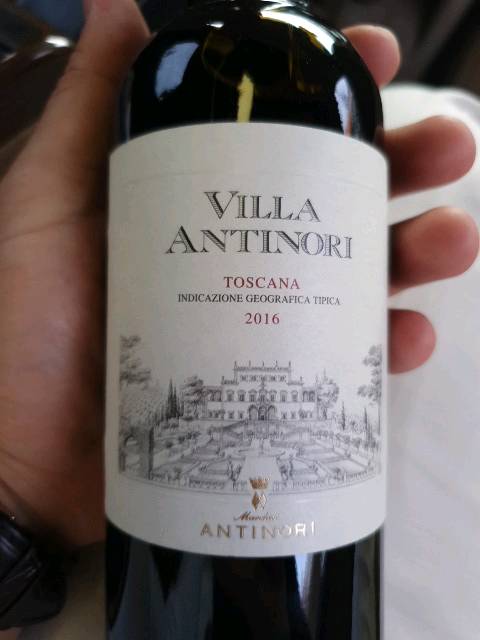
Villa Antinori Rosso Toscana IGT 2016
RedItaly2016
By Daniel Min · Tasted 2019-11-12 · Published 2026-09-04 · Updated 2026-09-04
At a glance
James Suckling 91 (Sep 2019) · one further critic review listed on Vivino, 91 · WineStatistics 92.6
Market note: A high-volume label with hundreds of thousands of bottles a year, so any vintage is easy to find. Vintage variation is small (Vivino 3.7–4.0).
What this wine is
The Antinori are a Florentine family who have made wine since 1385, now in their 26th generation. Tignanello and Solaia opened up the whole 'Super Tuscan' genre, but the label the family has carried longest is a different one: Villa Antinori. Marchese Niccolò Antinori launched it in 1928 with the family's villa drawn on the label, reportedly remarking that "France has its châteaux, but we have our villas." It remains the biggest share of Antinori's total production — the face of the house.
The grapes come from Antinori-owned vineyards across Tuscany. Sangiovese is the backbone, joined by Cabernet Sauvignon, Merlot, Syrah and Petit Verdot in proportions that change every year and are not published. In 2016, spring rain delayed flowering, but the summer was good and the wide day-night temperature swings in late August made for a well-ripened year. Each variety was fermented separately in stainless steel for 5–7 days with 8–12 days of skin contact — Cabernet, Sangiovese and Petit Verdot at 28°C, Merlot and Syrah below 25°C to preserve their aromatics. The wine then spent about 12 months in French, Hungarian and American oak (225 L) and was bottled in July 2018.
What the world says
James Suckling, 91 points. The Vivino community averages 3.8 across 11,083 ratings, with 62% at 4 stars or above. The keywords run oak, vanilla and tobacco; plum and blackberry; leather and earth; then cherry — with pepper (348 mentions) and citrus (218) also standing out. Structurally it is acidity 3.3/5, intensity 3.2, tannin 2.9: a textbook 'medium' Tuscan.
Vintage averages are almost flat, 3.7–4.0 between 2012 and 2023. The most recent vintages (2020–2023) sit slightly higher at 4.0, which tells you this is a wine whose young fruit plays best with a general audience. In other words, it is not a wine to lay down — buy it and drink it within two or three years.
"This little Antinori gem is a kind of 'baby Tignanello'. It goes with almost any food. Black and red fruit, light spice, leather." — Vivino review, Jul 2021, 4 stars (60 likes)
"Great value for a Sangiovese blend. Forest floor, black fruit, tobacco, vanilla. The acidity and balance make it dangerously easy to drink. A 'quality crowd-pleaser'." — Vivino review, May 2020, 4 stars (27 likes)
How I drank it
November 12, 2019, 4.5 stars. It was with fried chicken. The aromas I wrote down were lemon, grapefruit, creamy, mineral, blackcurrant, plum, vanilla, butter and strawberry, plus one line: "perfect aromatics and balance, like a Burgundy Pinot Noir."
Looking back, that sentence is where I diverge most from the community. The community puts oak, leather and tobacco up front; I caught the bright notes first — citrus and strawberry. Citrus does show up 401 times in the community keywords, so I wasn't inventing aromas, but it is clear that the fat and salt of the chicken that night pulled this wine's acidity and red fruit forward. A case of the pairing rewriting the note.
The 4.5 is not an absolute score; it is a score for 'this price, at this table'. Not many wines give you textbook Sangiovese-blend balance for around ₩40,000 (about US$29) and match Korean delivery fried chicken this well. This bottle was also my doorway into Antinori's upper range — Cervaro della Sala (4.5), Solaia 2012 (5). If you are drinking Antinori for the first time, this is the bottle I'd recommend to start with.
Vivino community data
2016 vintage rating distribution (11083 ratings, average 3.8)
| 5★ | 1058 (10%) | |
| 4★ | 5814 (52%) | |
| 3★ | 3799 (34%) | |
| 2★ | 286 (3%) | |
| 1★ | 126 (1%) |
Most-mentioned aromas
| Family | Mentions | Top keywords |
|---|---|---|
| Oak | 3989 | oak 1,652 · vanilla 866 · tobacco 577 · chocolate 350 |
| Black fruit | 2666 | plum 692 · blackberry 633 · black cherry 249 |
| Earth & leather | 2497 | leather 942 · earth 739 · smoke 285 |
| Red fruit | 2308 | cherry 1,220 · raspberry 228 · strawberry 148 |
| Spice | 872 | pepper 348 · licorice 152 |
| Citrus | 401 | citrus 218 · lemon 89 · grapefruit 54 |
Structure: Acidity 3.3/5 · Intensity 3.2/5 · Tannin 2.9/5 · Sweetness 1.7/5
Average by vintage (all vintages: 145190 ratings, average 3.9)
| Vintage | Average | Ratings |
|---|---|---|
| 2012 | 3.8 | 6231 |
| 2013 | 3.8 | 12714 |
| 2014 | 3.8 | 12459 |
| 2015 | 3.9 | 16012 |
| 2016 | 3.8 | 11083 |
| 2017 | 3.9 | 5716 |
| 2018 | 3.9 | 11709 |
| 2019 | 3.9 | 9355 |
| 2020 | 4.0 | 6653 |
| 2021 | 4.0 | 5168 |
| 2022 | 4.0 | 7950 |
| 2023 | 4.0 | 3763 |
My original note (Vivino, 2019-11-12)
“Lemon, grapefruit, creamy, mineral, black currant, plum, vanilla, butter, strawberry. Perfect scent and balance like burgundy pinot noir. The wine that goes well with fried chicken.”
Buying in Korea
Frequently asked questions
What kind of wine is Villa Antinori Rosso?
The flagship label of Tuscany's Antinori family, made since 1928 — a Toscana IGT red blending Sangiovese with Cabernet, Merlot, Syrah and Petit Verdot. Medium-bodied with cherry, plum, oak and leather, and good balance for the price, which makes it the usual entry point to Antinori.
How much does it cost?
Korean retail as of August 2026 is ₩36,000–45,000 (about US$26–33). Overseas retail is around US$20–25. Hypermarket promotions can bring it down to the low ₩30,000s (about US$22–24). The importer is Shindong Wine.
What food does it go with?
Per Vivino: beef, lamb, poultry and salami. In my own experience, fried chicken was an unexpectedly good match; the community often mentions barbecued pork ribs and meatball pasta.
Can I cellar it?
The suggested drinking window is 2018–2028, but vintage variation is small and the style is at its best with young fruit, so you are better off drinking it within two or three years of purchase. The 2016 is now in the latter half of its window.