Home › Wine Notes › Dom Pérignon (Moët & Chandon)
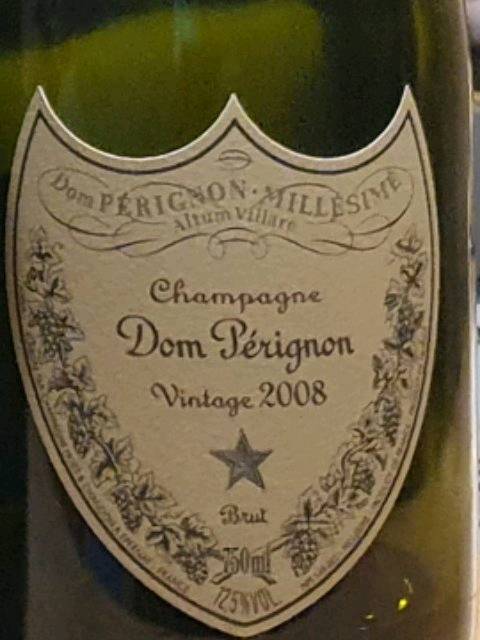
Dom Pérignon Vintage 2008
SparklingFrance2008
By Daniel Min · Tasted 2019-11-07 · Published 2026-09-03 · Updated 2026-09-03
At a glance
Owen Bargreen 97 (May 2025, drink 2025–2040) · Antonio Galloni 98 · Essi Avellan MW 97 · Jancis Robinson 18.5/20 · Wine-Searcher aggregate drinking window 2018–2048
Market note: Still reasonably available in Korea. Some stock turns up as 2008 bottles inside 2009 gift boxes (Dailyshot).
What this wine is
Dom Pérignon is the prestige cuvée of Moët & Chandon, and it is only ever a vintage Champagne. It is made only in good years, and there is no non-vintage bottling. The name comes from Pierre Pérignon, a 17th-century Benedictine monk at the Abbey of Hautvillers. The story that he 'invented' Champagne is an exaggeration, but he is remembered as the man who set the standards for blending and grape selection.
The 2008 vintage carries a few special footnotes. It was the first blend since 1990 to be exactly 50:50 Chardonnay and Pinot Noir, it spent about 9 years on the lees and then rested a further 12-plus months after disgorgement, making it the longest-aged Dom Pérignon among recent releases. That is why it was announced out of sequence in the second half of 2018 — after the 2009 (released May 2017) — and officially released on January 8, 2019. Dosage is a low 4 g/L.
This vintage is also the last work of Richard Geoffroy, chef de cave for 28 years. He retired at the end of 2018 and was succeeded by Vincent Chaperon, who had worked alongside him since 2005. Geoffroy called 2008 the 'miracle year'. A summer of grey skies promised an ordinary vintage, but September turned miraculously clear, and the harvest stretched over nearly a month as the team waited for full ripeness. The winemaking focused on taming the year's strikingly high acidity, and the result is a wine that is straight-lined yet concentrated, dense and textured.
What the world says
The 22 critics tracked by Wine-Searcher average 96/100, and 18 of them gave 95 or more. Antonio Galloni 98, Essi Avellan MW 97, Jancis Robinson 18.5/20. Owen Bargreen, tasting in May 2025, wrote of "white truffle, melon, citrus, Japanese pear tart. A silky mousse with power and finesse at once. Just now moving into its secondary aromas," and set the window at 2025–2040.
On Vivino more than 20,000 people have rated it, averaging 4.6, with 95% at 4 or above. The community keywords are overwhelmingly brioche, toast and almond, followed by apple, pear and green apple, then citrus, honey and mineral, and cream and yeast. Tropical fruit (pineapple, guava) is a minority at 613 mentions — and my note belongs to exactly that minority.
"Among the 2008s this one will stay with me. Even heavy barbecue smoke couldn't beat this concentrated nose." — Vivino review, Jul 2020, 5 stars (42 likes)
"The 08 is still young. I'm holding the rest." — Vivino review, Jan 2025, 4.7 stars (45 likes)
How I drank it
November 7, 2019, five stars. My first five-star Champagne, given just two weeks after I started using Vivino. The note from that night is short: apple, pineapple, tropical fruit, guava, plum, a huge rush of bubbles and a very long finish.
Looking back, two things are interesting. First, I wrote tropical fruit first, while the community writes brioche first. In late 2019 the wine was less than a year past release, so the fruit stood in front, and the 'white truffle, secondary aromas' the critics describe now are what developed in the bottle over the six years since. When you open the same wine changes the note. Second, the same evening I described a Santero Pinot–Chardonnay Brut as a 'budget Dom Pérignon' — so this bottle had clearly become the reference point for the night.
Since then my records show Dom Pérignon Rosé 2005 (5 stars) and 2006 (4), Vintage 2013 (4), and even a 1988 (1 star). The Rosé 2005 is the bottle that opened my eyes to rosé Champagne. Of all of them, 2008 is the vintage I would buy again without regret, and as the critics say it will easily run into the 2030s. That said, ₩700,000 (about US$507) buys a lot of other things, so please read this as: if you are choosing one bottle of Dom Pérignon, make it the 2008.
Vivino community data
2008 vintage rating distribution (20177 ratings, average 4.6)
| 5★ | 9534 (47%) | |
| 4★ | 9704 (48%) | |
| 3★ | 745 (4%) | |
| 2★ | 90 (0%) | |
| 1★ | 104 (1%) |
Most-mentioned aromas
| Family | Mentions | Top keywords |
|---|---|---|
| Yeast & bread | 7355 | brioche 2,547 · toast 2,165 · almond 955 · biscuit 411 |
| Tree fruit | 5863 | apple 2,026 · pear 1,197 · green apple 893 · peach 576 |
| Citrus | 5142 | citrus 2,596 · lemon 1,106 · grapefruit 455 |
| Earth & mineral | 3741 | honey 1,032 · mineral 986 · smoke 355 |
| Cream & yeast | 2832 | cream 1,564 · yeast 751 |
| Tropical fruit | 613 | pineapple 210 · tropical 200 · guava 44 |
Structure: Acidity 4.3/5 · Fizziness 4.2/5 · Intensity 3.9/5
Average by vintage (all vintages: 182688 ratings, average 4.6)
| Vintage | Average | Ratings |
|---|---|---|
| 2002 | 4.6 | 9383 |
| 2003 | 4.6 | 10003 |
| 2004 | 4.6 | 15577 |
| 2006 | 4.6 | 22465 |
| 2008 | 4.6 | 20177 |
| 2009 | 4.6 | 16967 |
| 2010 | 4.6 | 14343 |
| 2012 | 4.6 | 10596 |
| 2013 | 4.5 | 10052 |
| 2015 | 4.4 | 6129 |
My original note (Vivino, 2019-11-07)
“Apple, pineapple, tropical, guava, plum. A lot of carbonic-acid gas comes up and it finish is really long.”
Buying in Korea
Frequently asked questions
What makes Dom Pérignon 2008 special?
It is the first 50:50 Chardonnay–Pinot Noir blend since 1990, it spent about 9 years on the lees — the longest of any recent release — and it is the final vintage of Richard Geoffroy, chef de cave for 28 years. With 22 critics averaging 96 points it ranks among the very best Dom Pérignons of the 2000s.
Should I drink it now or keep it?
Either works. Right after release (2019) the fruit stood in front; a critic tasting in 2025 found the truffle and secondary aromas just beginning to emerge. Wine-Searcher's aggregate drinking window is 2018–2048. Open it now for freshness and maturity together, or in the 2030s for a wine led by aged aromas.
What does it cost in Korea?
As of August–September 2026, retail is ₩490,000–590,000 (about US$355–428) on online price comparisons and around ₩700,000 (about US$507) at the Namdaemun liquor market. The world average (ex-tax) is about ₩720,000 per bottle, so Korean pricing is not especially high. The official importer is Moët Hennessy Korea.
What food goes with it?
Per Vivino: shellfish, rich fish like salmon, pork and mild soft cheese. With its high acidity and brioche and nut aromas it is especially good with fried foods, oysters and white fish cooked in butter. Serve at 8–10°C — not too cold.
How is it different from Dom Pérignon P2?
P2 (Plénitude 2) is the same vintage aged around 15 further years on the lees and released a second time. The wine in this article is the first release (P1) of 2008; P2 is a separate product from the same vintage at a much higher price.