Home › Wine Notes › Casa Vinicola Natale Verga (Cermenate, Lombardia)
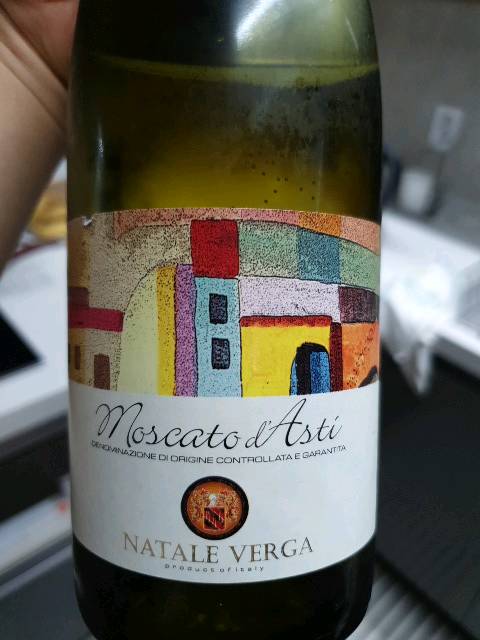
Natale Verga, Moscato d'Asti (NV)
White (semi-sparkling)ItalyNV
By Daniel Min · Tasted 2019-12-29 · Published 2026-09-16 · Updated 2026-09-16
At a glance
No Vivino or professional critic reviews on file.
Market note: A steady-selling casual Moscato d'Asti carried by US retailers (Martin's Wine, Haskell's, etc.) at everyday prices. Exact overseas retail price still being confirmed.
What this wine is
Moscato Bianco is believed to have reached Piedmont around the 5th century BCE, carried by Greek traders along the Ligurian coast. After founding the colony of Hasta — today's Asti — the Romans cultivated it as "Apiane" (the bee-attracting grape), and classical writers like Pliny the Elder recorded its aromatic prestige. In other words, the grape behind this wine has grown on these same hills for over two thousand years.
The light, low-alcohol Moscato d'Asti style we drink today, though, is a much more recent invention. In 1865, Carlo Gancia — trained in Champagne — applied the traditional Champagne method to Moscato Bianco, producing Italy's first sparkling wine and laying the groundwork for Asti Spumante. The real turning point came in 1898, when Asti native Federico Martinotti patented a sealed, low-temperature tank fermentation method (the autoclave) — later rediscovered in France as the Charmat method — which made today's light, gently frizzante, roughly 5%-ABV Moscato d'Asti possible to produce cheaply at scale. A consorzio fixed the production zone's boundaries in 1932, and Asti was elevated to DOCG status in 1993.
The house behind this particular bottle, Casa Vinicola Natale Verga, is not based in Asti at all but in Cermenate, Lombardy — a bottling house whose exact founding date isn't officially confirmed, but which today still wins gold medals (Berliner Wein Trophy, among others) as a mid-size négociant that buys Moscato from the Asti hills and bottles it under its own name.
What the world says
Vivino lists 643 ratings averaging 4.0 — a casual, everyday-wine category with no professional critic scores on file.
The flavor keywords lead with tree fruit — pear, peach, apple (33 mentions) — followed mostly by honey (part of a 22-mention earth group). Tropical fruit, mainly lychee and pineapple (13), also comes up often. Structure data is thin, based on just 4 user responses, but reads acidity 2.6/5, fizziness 1.1/5, intensity 2.5/5 — the low fizziness figure tracks with the semi-sparkling ("frizzante") category itself.
"If you like a light sparkling white wine, look no further. Very fresh, only 5% alcohol and flavours of peach, lychee." — Vivino review, Nov 2016, 4.0 stars
"Personally not a fan of 'moscato', but this one I would definitely do again… Great to finish the dinner." — Vivino review, Jul 2024, 4.0 stars
The low alcohol and pronounced sweetness push most community reviews toward a "nice light sipper" tone — nearly half a point below the 4.5 I gave it both times I drank it.
How I drank it
29 December 2019, 4.5 stars. "Bright pale gold. Lychee, apple, honey, stone, peach, asian pear. Balanced Moscato. Value for money. A moscato that's really good for light drinking. A taste anyone would casually enjoy. Unlike other moscatos, there's a distinctive finish that lingers and wraps around — that's what makes it special. It has an unusual Korean-pear-like note that I think Koreans would love~~^^" I picked the bottle up next to the strawberries at a supermarket while shopping for fruit.
I opened the same wine again on 4 January 2020. That night it shared the table with a Delamotte Brut Champagne Grand Cru, a Tommasi Amarone della Valpolicella 2015, and a Tenuta Regaleali Bianco 2016 — a dinner that opened with sparkling, peaked with Amarone, and closed with a Sicilian white, and this Moscato slotted in somewhere along that arc. The note was short: "Again pear and honey." Same score: 4.5.
Getting the identical score (4.5) both times wasn't a coincidence — it points to a wine that's simply consistent, satisfying in the same way every time. The "Korean pear" note from the first tasting and "pear and honey" from the second are the same impression, repeated. My score sitting half a point above the community average of 4.0 probably comes down to exactly that: most Vivino reviewers treat it as a light, casual wine, but for me that Korean-pear-like nuance landed as something more distinctive.
Vivino community data
NV vintage rating distribution (643 ratings, average 4.0)
| 5★ | 136 (21%) | |
| 4★ | 315 (49%) | |
| 3★ | 154 (24%) | |
| 2★ | 24 (4%) | |
| 1★ | 14 (2%) |
Most-mentioned aromas
| Family | Mentions | Top keywords |
|---|---|---|
| Tree fruit | 33 | pear 13 · peach 9 · apple 6 · asian pear 2 · apricot 1 |
| Earth & honey | 22 | honey 20 · stone 2 |
| Tropical fruit | 13 | lychee 8 · pineapple 4 · tropical 1 |
| Floral | 3 | acacia 2 · lily 1 |
| Red fruit | 2 | cotton candy 1 · fresh strawberry 1 |
| Dried fruit | 1 | prune 1 |
| Citrus | 1 | lemon 1 |
Structure: Acidity 2.6/5 · Fizziness 1.1/5 · Intensity 2.5/5
Average by vintage (all vintages: 643 ratings, average 4.0)
| Vintage | Average | Ratings |
|---|
My original note (Vivino, 2019-12-29)
“Bright pale gold. Lychee, apple, honey, stone, peach, asian pear. Balanced Moscato. Value for money. 가볍게 마시기 너무 좋은 모스카토. 어느 누구나 가볍게 맛있어 할 맛입니다. 다른 모스카토랑 다르게 끝에 잡고 감아주는 맛이 있어 특별합니다. 한국 배 맛이 특이하게 남아 한국사람들에게 사랑 받을 듯 합니다~~^^”
Frequently asked questions
What kind of wine is Natale Verga Moscato d'Asti?
A non-vintage, semi-sparkling white made from 100% Moscato Bianco in Italy's Asti DOCG, Piedmont. Alcohol: 5%. Vivino: 643 ratings averaging 4.0. Made by Lombardy-based bottler Casa Vinicola Natale Verga.
How much does it cost?
World average price: US$12 per 750ml ex-tax (Wine-Searcher, Sept 2026) (Wine-Searcher, to be confirmed). The casual Moscato d'Asti category overall tends to be inexpensive.
What food pairs well with it?
Vivino users suggest fruity desserts and aperitifs. With low alcohol (5%) and pronounced sweetness, it also pairs easily with fruit or lightly spiced Korean desserts.
Why is the alcohol only 5%?
Moscato d'Asti stops fermentation partway through using the sealed low-temperature tank method Federico Martinotti developed in 1898, leaving residual sugar and keeping pressure low (semi-sparkling). That method is what made this low-alcohol, light style viable to produce at scale.