Home › Wine Notes › Viña Tarapacá
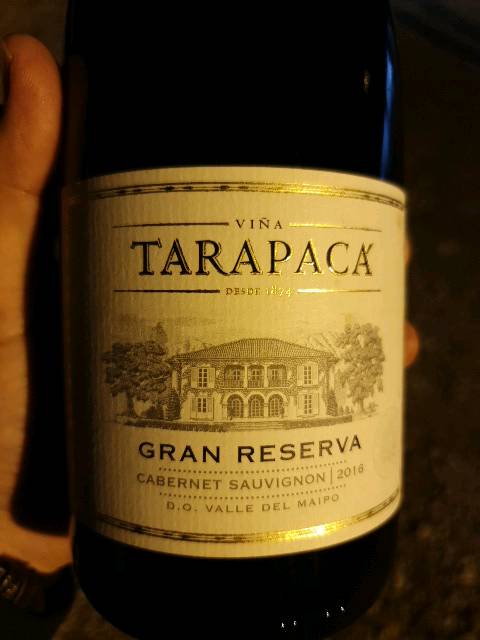
Viña Tarapacá Gran Reserva Cabernet Sauvignon 2016
RedChile2016
By Daniel Min · Tasted 2019-11-13 · Published 2026-09-07 · Updated 2026-09-07
At a glance
James Suckling 93 (2016) · 92 (2015) · 91 (2014) · critic review listed on Vivino 87 (Oct 2018)
Market note: A high-volume export label from the VSPT group, so it is easy to find almost anywhere in the world. Vintage variation is small (Vivino 3.8–4.0 across 2013–2023). In the US it also circulates under the black 'Etiqueta Negra' label.
What this wine is
Viña Tarapacá is one of Chile's oldest wineries, founded in 1874 by Francisco de Rojas in Isla de Maipo, south of Santiago. Two years later, in 1876, it took a silver medal at the Philadelphia World's Fair. The name, as the story goes, came during a change of ownership in the 1920s, borrowed from the nickname of two-time Chilean president Arturo Alessandri — 'El León de Tarapacá', the Lion of Tarapacá. Since 2008 it has belonged to VSPT (Viña San Pedro Tarapacá), Chile's second-largest wine exporter.
The vineyards sit on the El Rosario estate, wrapped in a bend of the Maipo River between the Andes and the Coastal Range. Cold air rolling down from the mountains and the river's own microclimate give hot days and cool nights, so the Cabernet Sauvignon ripens slowly. In the Tarapacá range, Gran Reserva is the middle tier — above the basic varietal and Reserva, below Gran Reserva Etiqueta Azul (Blue Label) — and it is the winery's best-selling bottle.
The 2016 Cabernet Sauvignon is 90% Cabernet Sauvignon and 10% Syrah according to the producer's notes (Vivino lists it as 100% Cabernet). It spent about 12 months in French oak and comes in at 13.5–14% alcohol. The producer describes it as "cherry, raspberry, plum, blackberry and blackcurrant, with caramel, toffee and vanilla from the oak, and ripe, rounded tannins."
What the world says
James Suckling gave the 2016 93 points, calling it "a dense, rich Cabernet that leans toward a Rhône style — earthy, with herbs, tobacco and spice." The 2015 got 92 and the 2014 got 91; Suckling consistently places this label in the low-to-mid 90s. The other critic review listed on Vivino is 87 points (Oct 2018).
The Vivino community averages 3.9 across 9,101 ratings. Seventy percent of those are 4 stars or higher — a far higher satisfaction rate than similarly priced Mouton Cadet (41%) or Villa Antinori (62%). The keywords run oak, tobacco and vanilla; blackberry, plum and blackcurrant; leather and smoke; then pepper — with a minority mentioning bell pepper (18 times) and violet (32 times). Structurally it reads intensity 4.1/5, which is quite big, with acidity 3.0 and tannin 3.2. In other words, the archetypal 'dense but not rough' Chilean Cabernet.
Vintage averages have barely moved in a decade: 3.8 for 2013, 3.9 for 2016, 4.0 for 2017–2018. Whichever year you buy, you are unlikely to be disappointed.
"Deep ruby. Fruit and bell pepper on the nose. Blackberry, plum, mocha. Medium-to-full body, medium-plus acidity. Good!" — Vivino review, Dec 2018, 4 stars (39 likes)
"Intense nose of oak and tobacco. Berries on the palate, velvety tannins, moderate acidity. Balanced and pleasant." — Vivino review, May 2018, 4 stars
"Dense, oaky, black fruit. Maybe a little too much. Worth drinking, but not one for the cellar." — Vivino review, May 2020, 4 stars
How I drank it
November 13, 2019, 3.5 stars. The note is a single word: "Good."
I was three weeks into keeping records, and on the same day I logged Almaviva 2016 (4.5) and Mouton Cadet 2016 (3). Tarapacá landed between them. Drunk beside Almaviva — another Maipo Cabernet — it must have felt comparatively simple, yet it was clearly better than the Mouton Cadet, hence 3.5. Looking at the data now, that order matches the community exactly (Almaviva 4.5 > Tarapacá 3.9 > Mouton Cadet 3.6). Three weeks in, I already had the relative ranking right.
If I drank it again, I suspect the score would go up, and the reason is price. This wine drops into the high teens of thousands of won during E-Mart promotions, and at that money a Suckling-93 Cabernet with 12 months in French oak is not something you find often. Oak, tobacco and blackberry is an obvious combination, but this wine does the obvious thing without a flaw, and it sits well with Korean grilled meat like yangnyeom galbi (marinated short ribs) or samgyeopsal (pork belly). If Almaviva answers 'how far can Chilean Cabernet go?', Tarapacá answers 'what do you buy if you drink Chilean Cabernet every day?'. On absolute terms I'll keep the 3.5, but if you ask about value, it's a 4.
Vivino community data
2016 vintage rating distribution (9101 ratings, average 3.9)
| 5★ | 1061 (12%) | |
| 4★ | 5269 (58%) | |
| 3★ | 2536 (28%) | |
| 2★ | 185 (2%) | |
| 1★ | 50 (1%) |
Most-mentioned aromas
| Family | Mentions | Top keywords |
|---|---|---|
| Oak | 1348 | oak 511 · tobacco 295 · vanilla 279 · chocolate 99 |
| Black fruit | 1114 | blackberry 336 · plum 212 · blackcurrant 177 · cassis 67 |
| Earth & leather | 523 | leather 171 · smoke 113 · earth 91 |
| Spice | 382 | pepper 221 · licorice 47 · mint 37 · menthol 22 |
| Red fruit | 354 | cherry 155 · raspberry 58 · strawberry 50 |
| Vegetal | 55 | bell pepper 18 · grass 7 |
| Floral | 47 | violet 32 |
Structure: Acidity 3.0/5 · Intensity 4.1/5 · Tannin 3.2/5 · Sweetness 1.9/5
Average by vintage (all vintages: 74944 ratings, average 3.9)
| Vintage | Average | Ratings |
|---|---|---|
| 2010 | 3.7 | 3731 |
| 2011 | 3.6 | 3418 |
| 2012 | 3.7 | 3086 |
| 2013 | 3.8 | 7326 |
| 2014 | 3.9 | 4780 |
| 2015 | 3.9 | 7518 |
| 2016 | 3.9 | 9101 |
| 2017 | 4.0 | 10993 |
| 2018 | 4.0 | 7127 |
| 2019 | 3.9 | 3330 |
| 2020 | 4.0 | 2643 |
| 2021 | 3.9 | 1936 |
| 2022 | 4.0 | 3189 |
| 2023 | 3.9 | 1116 |
My original note (Vivino, 2019-11-13)
“Good.”
Buying in Korea
Frequently asked questions
What kind of wine is Tarapacá Gran Reserva Cabernet Sauvignon?
A Cabernet-led red from Viña Tarapacá (founded 1874) in Chile's Maipo Valley. About 12 months in French oak, 13.5–14% alcohol. A dense, rounded Chilean Cabernet with blackberry, plum, oak, tobacco and pepper; James Suckling 93 (2016), Vivino 3.9.
How much does it cost?
Korean retail is ₩31,000–37,000 (about US$22–27; Vinobot, Aug 2026). It is famous as a 'sale wine', dropping to ₩16,000–20,000 (about US$12–14) in E-Mart promotions and around ₩28,000 (about US$20) at Costco. Overseas retail is US$15–18. The importer is HiteJinro.
What food does it go with?
Per Vivino: beef, lamb, poultry and game. In Korea, reviewers often pair it with yangnyeom galbi (marinated short ribs), samgyeopsal (pork belly) and steak. It is a high-intensity wine, so grilled dishes suit it better than lighter fare.
What is the difference between Gran Reserva, Reserva and Etiqueta Negra?
The Tarapacá range runs Varietal < Reserva < Gran Reserva < Gran Reserva Etiqueta Azul (Blue Label). The black-label 'Etiqueta Negra' sold in the US is the same tier as the Gran Reserva sold in Korea. Gran Reserva is the first tier in the range to see French oak.