Home › Wine Notes › Viña Almaviva (Baron Philippe de Rothschild × Concha y Toro)
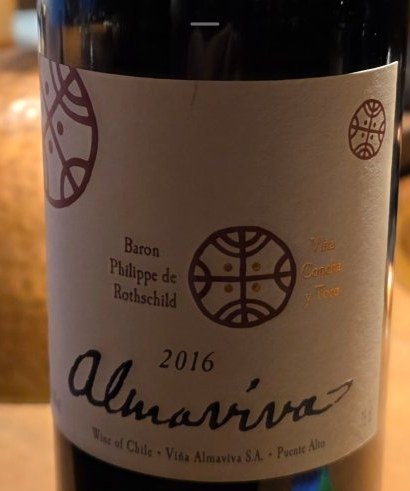
Almaviva 2016
RedChile2016
By Daniel Min · Tasted 2019-11-13 · Published 2026-09-04 · Updated 2026-09-04
At a glance
James Suckling 97 · Wine Spectator 95 · Wine Advocate 94 · JancisRobinson.com 17.5/20 (critic reviews as listed on Vivino, tasted 2018)
Market note: The 2016 is nearly sold through overseas; the 2021 vintage sits around US$166 (wine.com). Korea still has 2016 stock on shelves.
What this wine is
Almaviva is a joint venture founded in 1997, funded half-and-half by France's Baron Philippe de Rothschild (owner of Château Mouton Rothschild) and Concha y Toro, Chile's largest wine company. The name comes from Count Almaviva in Beaumarchais's play The Marriage of Figaro, and the circular motif on the label is a stylized kultrun, the ceremonial drum of Chile's indigenous Mapuche. The first vintage was 1996. Think of it as the Chilean re-run of what Opus One (Mouton × Mondavi) did in Napa.
The vineyard sits in Puente Alto, just southeast of Santiago in the Andean foothills at roughly 650 m above sea level. It is gravelly alluvial soil on the upper Maipo River, the source of Chile's finest Cabernet (Don Melchor and Viñedo Chadwick are neighbours). Around 85 ha yield roughly 200,000 bottles a year, and Frenchman Michel Friou has been technical director since the 2008 vintage.
The 2016 is 66% Cabernet Sauvignon, 24% Carmenère, 8% Cabernet Franc and 2% Petit Verdot, aged 16 months in new French oak. That year the spring was colder and wetter than usual, which cut cluster counts; the summer was especially hot and dry in December and February; and heavy rain in April (109 mm) forced an early harvest. Picking began with Merlot on 29 March and finished on 6 May, about two weeks ahead of the norm. The winery's own note lists raspberry and blackberry with toffee and coffee, 'a round, fresh texture and a finish of vanilla and pepper.'
What the world says
The critics: James Suckling 97 ('fresh fruit and herbs, medium-to-full body with a tight, focused structure'), Wine Spectator 95 ('elegant, powerful and well-knit, with black fruit, dried red fruit and spice'), Wine Advocate 94 ('earthy, damp-forest nuances, herbs, soft and powdery tannins'). Jancis Robinson 17.5/20. Among Almaviva vintages, 2016 is filed under the 'elegant' years. The Vivino average, which ran 4.6–4.7 from 2010 to 2015, slipping to 4.5 for 2016 reads to me as a year that chose finesse over power.
The 2,735 Vivino ratings are dominated by oak, vanilla, chocolate and tobacco, followed by blackberry and cassis, leather and earth, and then pepper (181 mentions), licorice and mint. Structure: intensity 4.6/5, tannin 3.5, acidity 3.0.
"Tasted blind. The cedar, tobacco and red bell pepper said Chile to me, and I guessed Almaviva. Dark chocolate, blueberry, cassis, cherry, leather. Went well with steak." — Vivino review, May 2024, 4.5 stars (55 likes)
"Cassis, blackcurrant, vanilla, mountain herbs, cocoa, leather. Tremendous concentration, velvety yet chewy tannins. Beautifully balanced." — Vivino review, Dec 2021, 4.5 stars
How I drank it
13 November 2019, 4.5 stars. I was three weeks into Vivino, logged five bottles that day alone, and my Almaviva note was exactly two words: Strong pepper. Where the community leads with oak and black fruit, I led with pepper — and in the community keywords, pepper is in fact the top spice descriptor (181 mentions). Those two words hold my first encounter with the black-pepper and bell-pepper streak that 24% Carmenère brings to the blend.
I've had it twice more since: 4 stars in January 2025, then 4.5 again in March 2026. Three bottles of the same 2016 across six years, and the score never leaves the 4–4.5 band — which is, in itself, the description of this wine. In 2019 the pepper jumped out; in 2025 it had settled and the wine felt a touch plain; in 2026 the leather, tobacco and cassis had fused into one piece and I liked it again. With a drinking window out to 2036, we are right at the midpoint.
At ₩400,000-plus (about US$290), the same money buys a Bordeaux second growth or a very good Napa Cabernet. The reason to choose Almaviva anyway is that it shows, in a single bottle, how far Chilean Cabernet can go. If you're opening it with someone tasting it for the first time, an elegant year like 2016 is the right call; if you want power for yourself, seek out 2010 or 2015 instead.
Vivino community data
2016 vintage rating distribution (2735 ratings, average 4.5)
| 5★ | 1010 (37%) | |
| 4★ | 1575 (58%) | |
| 3★ | 116 (4%) | |
| 2★ | 16 (1%) | |
| 1★ | 18 (1%) |
Most-mentioned aromas
| Family | Mentions | Top keywords |
|---|---|---|
| Oak | 2082 | oak 449 · vanilla 414 · chocolate 368 · tobacco 283 · coffee 123 |
| Black fruit | 1662 | blackberry 473 · cassis 237 · blackcurrant 216 · plum 195 |
| Earth & leather | 803 | leather 251 · earth 137 · smoke 128 |
| Spice | 591 | pepper 181 · licorice 140 · mint 90 · eucalyptus 40 |
| Red fruit | 358 | cherry 166 · raspberry 44 |
| Floral | 109 | violet 61 · lavender 19 |
Structure: Intensity 4.6/5 · Tannin 3.5/5 · Acidity 3.0/5 · Sweetness 1.9/5
Average by vintage (all vintages: 55993 ratings, average 4.6)
| Vintage | Average | Ratings |
|---|---|---|
| 2010 | 4.7 | 4138 |
| 2011 | 4.6 | 3516 |
| 2012 | 4.6 | 3895 |
| 2013 | 4.6 | 3721 |
| 2014 | 4.6 | 3629 |
| 2015 | 4.6 | 3452 |
| 2016 | 4.5 | 2735 |
| 2017 | 4.6 | 2330 |
| 2018 | 4.6 | 1612 |
| 2019 | 4.5 | 1283 |
| 2020 | 4.5 | 1144 |
| 2021 | 4.4 | 854 |
My original note (Vivino, 2019-11-13)
“Strong pepper.”
Buying in Korea
Frequently asked questions
What kind of wine is Almaviva?
The flagship of a joint-venture winery founded in 1997 by the Rothschild family of Mouton Rothschild and Chile's Concha y Toro. It is a Bordeaux-style red built on Cabernet Sauvignon from Puente Alto, Chile, blended with Carmenère, Cabernet Franc and Petit Verdot, and one of the country's defining 'icon wines'.
What was the 2016 vintage like?
A cold, wet spring reduced yields, the summer was hot and dry, and April rain pushed the harvest two weeks earlier than usual. It is rated a vintage of elegance rather than power, with 97 points from James Suckling and 95 from Wine Spectator.
Is it ready to drink now?
Yes. Vivino's suggested window is 2021–2036. In 2019 the pepper and fruit leapt out; by 2026 the leather, tobacco and cassis had knit together. I'd decant it one to two hours before drinking.
How much does it cost in Korea?
Korean retail as of August 2026 is ₩370,000–480,000 (about US$270–350). Overseas retail runs US$150–170. Recent vintages (2020–2022) circulate alongside 2016 stock, so check the vintage on the label before buying.
What food does it pair with?
Vivino suggests beef, veal, poultry and pasta. With its firm tannin and pepper-and-tobacco aromatics, it is especially good with charcoal-grilled steak, lamb chops and anything cooked with plenty of pepper.