Home › Wine Notes › Baron Philippe de Rothschild S.A.
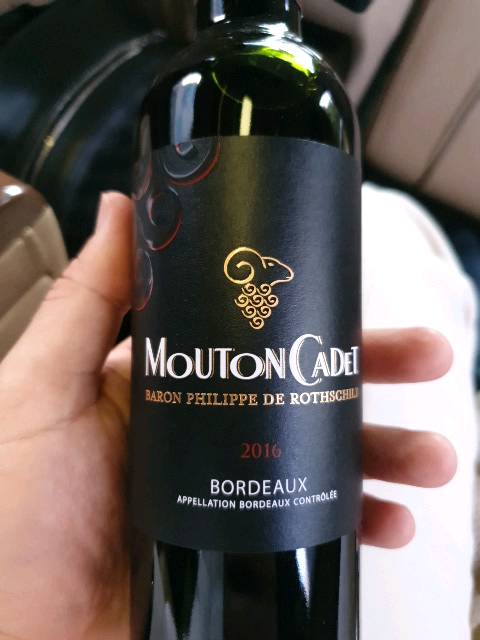
Mouton Cadet Rouge Bordeaux 2016
RedFrance2016
By Daniel Min · Tasted 2019-11-13 · Published 2026-09-07 · Updated 2026-09-07
At a glance
Social Vignerons 87 · No official scores from the major critics (Parker, Suckling) — as a mass-market brand it simply isn't reviewed
Market note: Tens of millions of bottles a year; 155 vintages are registered on Vivino. Relaunched as the 'new Mouton Cadet' from the 2015 vintage (more Merlot, more Right Bank fruit).
What this wine is
Let's clear up the misunderstanding first. Mouton Cadet is not Château Mouton Rothschild. In 1930, a twenty-something Baron Philippe de Rothschild took grapes from a poor harvest that he felt were not worthy of the first-growth label and made a second wine, naming it 'Mouton Cadet' after himself — the youngest (cadet) of the family. When it caught on, by the late 1930s it had become a separate brand made from grapes bought across Bordeaux, not from the Mouton vineyards at all. Today Mouton Cadet is Baron Philippe de Rothschild S.A.'s mass-market brand, sharing only its name and the ram crest with Mouton Rothschild.
The scale is bigger than you would guess. Fruit comes from 453 contract growers and 1,520 hectares across Bordeaux, and the wine sells in 150 countries — hence the tag 'the world's best-selling Bordeaux.' From the 2015 vintage it was relaunched as the 'new Mouton Cadet,' moving nearly half of its contracted vineyards to the Côtes de Bordeaux (the Right Bank hills) and sharply raising the share of Merlot. The stated goal of head winemaker Pierre Lambert: "rounder, softer, more juicy."
The 2016 Rouge is 83% Merlot, 10% Cabernet Sauvignon, 7% Cabernet Franc. The producer's note speaks of raspberry, cherry and strawberry jam with menthol and licorice. The oak is a brief brush, and the wine is built to be drunk straight after bottling. Alcohol on the label: 13.5%.
What the world says
13,630 Vivino ratings, averaging 3.6. Three stars is the most common score (49%), with 41% at four or above. Aroma keywords run blackberry, blackcurrant and plum, then oak, vanilla and tobacco, then cherry, then earth and leather, with pepper (212 mentions) and cheese (133) trailing. Structure: acidity 3.8/5, intensity 3.8, tannin 3.5 — the community filing it under 'full-bodied, high acidity' means the frame is fairly sharp for a Merlot-led Bordeaux.
The vintage trend is interesting. The 2010–2013 vintages hovered at 3.3–3.4, then rose steadily: 3.5 in 2015, the first year of the relaunch, 3.6 in 2016, up to 3.8 in 2019. That is the community's testimony that the brand actually got better. The 2016 sits in the middle of that climb.
"Earth, leather, tobacco, mushroom, ripe bruised blackberry, red cherry. Complex tannins and a long finish. Enjoyable and cheap." — Vivino review, Dec 2019, 4 stars
"Sour cherry and clove. Leathery tannins. Wish the finish were a bit longer, but good for the price." — Vivino review, Jan 2020, 4 stars (19 likes)
"Lots of spice on the nose. Pepper, young red plum, licorice. Chalky tannins. Sour, bitter aftertaste. Still rough and green." — Vivino review, Jul 2023, 3.7 stars
Social Vignerons gave the 2016 Rouge 87 points, writing of "fresh raspberry and blueberry, a touch of vanilla and chocolate, red bell pepper and violet, peppermint," and judged it better than the 2014. The major critics — Parker, Suckling, Spectator — do not issue official scores for this wine. It is a wine for distribution, not for criticism.
How I drank it
November 13, 2019, 3 stars. The note is two words: "Ordinary Bordeaux."
I was three weeks into recording wines at the time, and on the same day I gave Almaviva 2016 4.5 stars and wrote "Strong pepper." The Mouton Cadet drunk alongside it would have been a bottle with neither pepper nor intensity — ordinary, quite literally. Looking at the community data now, that judgment was accurate. Take away the name 'Mouton' and this is a ₩30,000 Merlot-led Bordeaux, with nothing in particular to remember beyond sour cherry, plum, a little oak and a little earth.
But six years on, there is something I want to add. The ordinariness is not a flaw; it is the design. The same taste whether you buy it in any of 150 countries, acidity that copes politely with steak or bulgogi (marinated beef) alike, a softness that lets you drink it the moment it's open. For someone drinking their first Bordeaux, it is the first page of the textbook: 'Bordeaux tastes roughly like this.' I never bought it again, and for the same money Villa Antinori Rosso or Tarapacá Gran Reserva gave me far more pleasure. But it is also true that when you have to grab a bottle from a convenience store in a hurry, this is a name that does not fail you. Three stars does not mean bad; it means exactly as much as you expected.
Vivino community data
2016 vintage rating distribution (13630 ratings, average 3.6)
| 5★ | 998 (7%) | |
| 4★ | 4621 (34%) | |
| 3★ | 6734 (49%) | |
| 2★ | 1001 (7%) | |
| 1★ | 276 (2%) |
Most-mentioned aromas
| Family | Mentions | Top keywords |
|---|---|---|
| Black fruit | 2035 | blackberry 651 · blackcurrant 461 · plum 335 |
| Oak | 1750 | oak 794 · vanilla 332 · tobacco 251 · chocolate 103 |
| Red fruit | 1226 | cherry 594 · raspberry 155 · strawberry 116 |
| Earth & leather | 1015 | earth 384 · leather 288 · smoke 109 |
| Spice | 440 | pepper 212 · licorice 86 |
| Dairy | 180 | cheese 133 · cream 29 |
Structure: Acidity 3.8/5 · Intensity 3.8/5 · Tannin 3.5/5 · Sweetness 1.5/5
Average by vintage (all vintages: 115372 ratings, average 3.6)
| Vintage | Average | Ratings |
|---|---|---|
| 2010 | 3.4 | 3749 |
| 2011 | 3.4 | 7004 |
| 2012 | 3.4 | 8226 |
| 2013 | 3.3 | 8058 |
| 2014 | 3.5 | 10009 |
| 2015 | 3.5 | 11695 |
| 2016 | 3.6 | 13630 |
| 2017 | 3.6 | 9396 |
| 2018 | 3.7 | 10262 |
| 2019 | 3.8 | 7082 |
| 2020 | 3.7 | 4973 |
| 2021 | 3.7 | 3112 |
| 2022 | 3.7 | 3941 |
| 2023 | 3.7 | 1102 |
My original note (Vivino, 2019-11-13)
“Ordinary bordeaux.”
Buying in Korea
Frequently asked questions
Is Mouton Cadet the same wine as Château Mouton Rothschild?
No. The same company (Baron Philippe de Rothschild) makes both, but Mouton Rothschild is a first-growth grand cru from Pauillac, while Mouton Cadet is a mass-market Bordeaux AOC brand made from contract growers' grapes across the region. Baron Philippe named it in 1930 after himself, the 'cadet' (youngest) of the family. The price difference is a matter of dozens of times over.
How much does it cost?
Korean retail ₩30,000–34,000 (about US$22–25), and around ₩28,000 (about US$20) during hypermarket and convenience-store promotions (Vinobot, 2022). Overseas retail is about US$10–14, so Korea pays roughly double. The importer is Interliquor (it has changed over the years).
What food does it go with?
Per Vivino: beef, veal, poultry, game. With its high acidity and medium tannin it also copes fine with sweet-and-savory marinated meats like bulgogi (marinated beef) and yangnyeom galbi (marinated short ribs).
Is the 2016 vintage still good to drink now?
The suggested window is 2018–2028, but this is not a wine that improves with keeping. If you still have one, drink it now; if you are buying new, recent vintages (2019 onward, averaging 3.7–3.8) are rated higher by the community.