Home › Wine Notes › Víno Mrva & Stanko
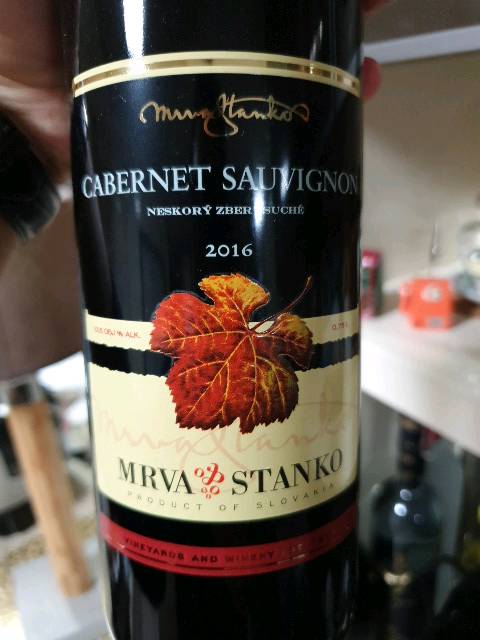
Mrva & Stanko Cabernet Sauvignon 2016 (Slovakia)
RedSlovakia2016
By Daniel Min · Tasted 2019-11-13 · Published 2026-09-09 · Updated 2026-09-09
At a glance
No scores from international critics. The winery cites dozens of international and hundreds of domestic competition awards, but none could be confirmed for this vintage.
Market note: The Vivino data is thin: 84–94 ratings per vintage, and only two users entered structure values, so the 4.3 acidity and 3.9 tannin are closer to estimates. Vintage averages sit tightly at 3.6–3.8, and the reviews are almost all from Slovak and Czech users.
What this wine is
Slovakia is a wine country. Its western and southern borders with Austria, Hungary and the Czech Republic hold six wine regions, and a slice of Hungary's Tokaj even spills over onto the Slovak side. Most of what it makes, though, is drunk at home and rarely leaves. Trnava is an old town about 50 km north-east of Bratislava, on the eastern foothills of the Little Carpathians. Mrva & Stanko was founded there in 1997 by Peter Stanko, an advertising man, and Vladimír Mrva, a winemaker with international experience. It began with 12,000 bottles and now makes 400,000 a year — a mid-sized house widely credited with bringing the first 'modern' wines to the Slovak market. The vine leaf in its logo, it says, means that 'wine is decided in the vineyard'. Fruit comes from three regions — the Little Carpathians (Modra, Dolné Orešany, Vištuk), Nitra and South Slovakia — and the range runs white, rosé, red and sparkling plus a small 'Winemaker's Cut' series.
The Cabernet Sauvignon comes from the South Slovak region. Close to the Danube, it is the warmest part of the country and one of the few places late-ripening varieties can be planted. For recent vintages the winery names the Kamenný Most vineyard, gives 13.5% alcohol and 2–8 years of bottle age, and describes the wine as "deep ruby-garnet, blackcurrant and graphite on the nose, a concentrated palate of juicy stone fruit, balanced acidity and tannin, a finish of spice." Whether the 2016 came from the same vineyard, or how much oak it saw, I could not confirm. That is about all the outside world can know about this bottle.
What the world says
The world has not said much. Neither the Wine Advocate nor Spectator nor Decanter has ever scored it, and Wine-Searcher shows no international trade. That leaves Vivino, and even that is thin: 84 ratings for the 2016 at an average of 3.8, 569 for the label as a whole at 3.8. 62% rate it 4 or higher; nobody has given it 1 star. Only two users entered structure values, so treat the 4.3 acidity, 3.9 tannin and 1.4 sweetness as a rough guide. Keywords: blackcurrant, blackberry, cassis; chocolate and vanilla; cherry and raspberry. The textbook list for a Bordeaux-style Cabernet.
The reviews are almost all by Slovaks and Czechs, and the tone is uniform. Nobody is amazed, nobody is disappointed.
"Definitely worth 4 stars. Drank the 2016 in 2020. Deep red, aromas of pepper, plum and blackcurrant. Ripe fruit on the palate, rich in tannin, a little bitter at the back of the tongue. Long finish." — Vivino review, Feb 2020, 4 stars
"2016 vintage. Garnet with lighter edges. Oak and cherry, a bit smoky. Caramel and cassis, full-bodied. This bottle was at exactly the right time to drink." — Vivino review, Oct 2021, 3.5 stars
"Medium ruby. Blackcurrant, blackberry, grass, a medium finish with a hint of vanilla. 3.3." — Vivino review, Dec 2020, 3 stars
What strikes me is how closely the numbers track the Tarapacá Gran Reserva I drank the same day (Vivino 3.8, my score 3.5). Community 3.8, me 3.5. Slovakia or Chile, a well-made mid-priced Cabernet lands in this spot.
How I drank it
November 13, 2019, 3.5 stars. "Good."
Three weeks into keeping records, on the day I logged sixteen bottles in one go. This one sits right after Samantha's Garden at 4.5 and right before Graham's Six Grapes at 1. It is also the only Slovak wine in my entire Vivino history.
Honestly, I have no memory of how this bottle reached my glass. I looked for a Korean import record and found none. Lotte Liquor once brought in a few Czech and Slovak wines and gave up; these days natural-wine importers handle a few small Slovak growers, but Mrva & Stanko is on none of their lists. Someone must have carried it back from Slovakia, or it was a gift, or it belonged to whoever else was at the table. Given the bottles logged alongside it that day — Almaviva, Veuve Clicquot, Two Hands, Alta Vista — it was very likely a gathering where many bottles went round.
One word, 'Good', and 3.5 stars. I gave Tarapacá Gran Reserva the identical 'Good' and 3.5 the same day. Back then 3.5 meant 'nothing wrong with it, nothing to remember either'. It is not far from the community's 3.8, so I do not think the call was wrong. What I would notice today is that 4.3 acidity: this is clearly fresher than a Chilean or Australian Cabernet, and that freshness is presumably the identity of a cool Cabernet grown beside the Danube.
Could I drink it again? Not in Korea. So this bottle goes not on the re-taste list but on the 'if I ever get to Trnava' list. The winery runs sommelier-led tastings and a tour through an underground tunnel. The chance to turn a 3.5-star 'Good' into a proper sentence is there.
Vivino community data
2016 vintage rating distribution (84 ratings, average 3.8)
| 5★ | 6 (7%) | |
| 4★ | 46 (55%) | |
| 3★ | 28 (33%) | |
| 2★ | 4 (5%) | |
| 1★ | 0 (0%) |
Most-mentioned aromas
| Family | Mentions | Top keywords |
|---|---|---|
| Black fruit | 41 | blackcurrant 11 · blackberry 9 · cassis 5 · blueberry 4 |
| Oak | 21 | chocolate 5 · vanilla 4 · dark chocolate 3 · oak 3 · tobacco 3 |
| Red fruit | 11 | cherry 5 · raspberry 3 · strawberry 3 |
| Earth & leather | 6 | smoke 3 · cocoa 1 · graphite 1 |
| Spice | 3 | pepper 3 |
| Vegetal | 2 | gooseberry 1 · grass 1 |
Structure: Acidity 4.3/5 · Intensity 4.0/5 · Tannin 3.9/5 · Sweetness 1.4/5
Average by vintage (all vintages: 569 ratings, average 3.8)
| Vintage | Average | Ratings |
|---|---|---|
| 2011 | 3.7 | 71 |
| 2012 | 3.8 | 94 |
| 2015 | 3.6 | 94 |
| 2016 | 3.8 | 84 |
| 2018 | 3.8 | 84 |
My original note (Vivino, 2019-11-13)
“Good.”
Buying in Korea
Frequently asked questions
What kind of winery is Mrva & Stanko?
A winery in Trnava, western Slovakia, founded in 1997 by advertising man Peter Stanko and winemaker Vladimír Mrva. It grew from 12,000 bottles in its first year to 400,000 a year, making white, rosé, red and sparkling wines from three regions: the Little Carpathians, Nitra and South Slovakia. The Cabernet Sauvignon comes from the Kamenný Most vineyard in the warmest region, South Slovakia (for recent vintages).
How much is it, and can I buy it in Korea?
I could find no record of official Korean import, and it is not on Vinobot. Slovak retail is about €18 (2022 vintage, roughly ₩27,000 or US$20). A trip to Slovakia or a gift from a friend is effectively the only way.
What food goes with it?
Vivino suggests beef, lamb, game, mature hard cheese and mushrooms. The winery recommends 16–18°C with venison steak, beef dishes, red-wine reductions, wild mushrooms and aged hard cheese. With its high acidity it suits a lean sirloin or a mushroom dish better than fatty galbi (short ribs).
Can Slovak wine be trusted?
Slovakia is an old wine country bordering Austria and Hungary; it is little known abroad simply because most of its wine is drunk at home. This wine has no critic scores, but 569 Vivino users average 3.8 and vintage variation is small, 3.6–3.8. It sits in the same spot as Chile's Tarapacá Gran Reserva (3.8).