Home › Wine Notes › Moillard (Thomas-Moillard, Nuits-Saint-Georges)
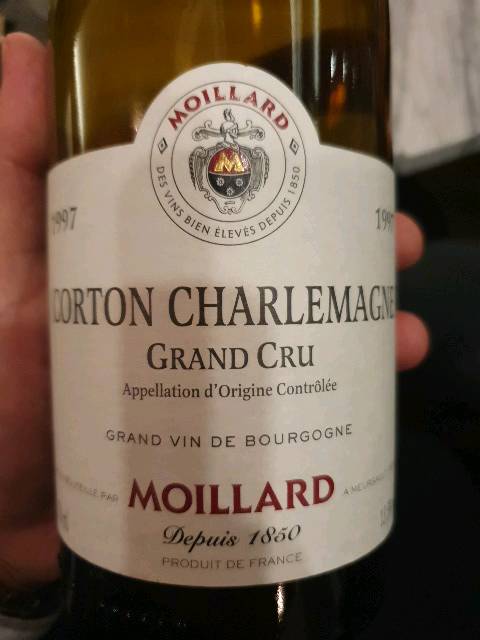
Moillard, Corton-Charlemagne Grand Cru 1997
WhiteFrance1997
By Daniel Min · Tasted 2019-12-19 · Published 2026-09-15 · Updated 2026-09-15
At a glance
No critic reviews on record
Market note: This vintage has only 12 Vivino ratings, too few for an official average (BelowThreshold). Producer's description: "Pale golden color which changes shade over time. The nose has a great aromatic complexity that gains strength with aeration: candied orange, hawthorn, hazelnut, hot brioche... These greedy and generous flavors on the palate, alongside a nice acid characteristic of the vintage frame, provide great length in the mouth and a good ageing potential."
What this wine is
The legend of the Corton hill begins with Charlemagne. In the late 8th century this Holy Roman Emperor owned the Corton vineyards and is said to have donated most of them to the Abbey of St. Andoche. The trouble was his taste for red wine. As the story goes, his fourth wife, Luitgard, was displeased that red wine kept staining his white beard, so she had one section of the hill pulled up and replanted with white grape varieties — the section known today as Corton-Charlemagne (this is legend; the one confirmed fact is that the name "Clos de Charlemagne" first appears in a document from 1375).
The house behind this bottle, Moillard, is a négociant not far from that same hill, in Nuits-Saint-Georges. Symphorien Moillard started the business in 1848 when he married Marguerite Grivot, and it really took off after 1850, when a chance meeting with a Belgian notary opened up export routes to Belgium. In 1870 his daughter Jeanne inherited the firm and, through her marriage to Maurice Thomas, it became Thomas-Moillard; Charles Thomas ran it for seventy years, buying up most of its vineyard holdings along the way. But in the 2000s, inheritance disputes within the Thomas-Moillard family led a majority of shareholders to want out, and Vincent Sauvestre — owner of the Meursault négociant Jean-Baptiste Béjot — ended up acquiring Moillard. A hundred and fifty years of family ownership came to an end.
1997 is generally considered a solid year for white Burgundy. Alcohol is 13.6%, 100% Chardonnay. Twenty-two years on, this bottle also illustrates one of white Burgundy's long-running problems: "premox," premature oxidation, especially notorious in vintages from the late 1990s through the early 2000s. Cork defects, overripe fruit from warming vintages, excessive lees-stirring (bâtonnage) and insufficient sulfur have all been blamed, and the industry has since tightened cork quality control and pulled back on bâtonnage.
What the world says
This 1997 vintage carries no listed critic score on Vivino. Community ratings haven't cleared Vivino's sample threshold either — just 12 of them, so no official average shows (BelowThreshold) — but doing the math gives 4.1 (one 3-star, nine 4-star, two 5-star), with 92% at four stars or above. Across the whole label, 90 ratings average 3.9.
The reviews hover somewhere between oxidation and graceful age. A March 2018 review: "Cork was stained with fungi, color was golden yellow, looks so old. But acidity still strong! Even it has been 21 years matured" (4.0 stars). A September 2021 review: "31 year old wine. A bit oxidized, bitter citrus peel on the finish" (3.5 stars — the '31 years' doesn't match the vintage math, but I've kept the review as written). An August 2019 review lists apricot, apple, peach, pear, citrus, yeast, earthy, high minerality, honey, marmalade and calls it "elegant, dignifying, so great old vintage wine" (4.0 stars). A December 2017 review: "Smells of sea at beginning. Nice mineral and acidity. Tight mouthfeel. Bottle condition was so good" (4.0 stars).
"31 year old wine. A bit oxidized, bitter citrus peel on the finish." — Vivino review, Sep 2021, 3.5 stars
Vivino's flavor keywords lead with apple, apricot, peach and pear (5 mentions), alongside citrus (4) and oak (4: oak, butter, coffee), with earthy, honey and minerals (3) close behind. Structure: acidity 3.4/5, intensity 4.0 — consistent with reviews noting the acid is still very much alive at 22 years.
How I drank it
19 December 2019, 4.5 stars. "Cork is half stained. But I just feel deep deep vanilla. And my company said I wanna eat with a hamburger. It was completely butter like mayonnaise. I'm sure it will become oak flavor."
That night I opened this Moillard Corton-Charlemagne 1997 alongside Krug Grande Cuvée (5.0) and Tenuta Luce 2012 (3.5). A 22-year-old white Burgundy to start, a non-vintage Champagne in the middle, a Tuscan red to close — the Corton-Charlemagne came in second of the three, behind the Krug.
My companion's "like butter" read matches Vivino's oak/butter keywords exactly, and the vanilla I noted is itself an oak-ageing signature — a sign that, at 22 years, this bottle still read as fresh rather than tired. Against the label's overall average of 3.9 and this vintage's unofficial 4.1, my 4.5 sits above both.
Where this wine shows up
Charlemagne is said to have owned the Corton hill and donated most of it to the Abbey of St. Andoche. Legend holds that his fourth wife, Luitgard, disliked red wine staining her husband's white beard, so she had one section of the hill replanted with white grape varieties — the section known today as Corton-Charlemagne (this is legend; the one confirmed fact is that the name "Clos de Charlemagne" first appears in a document from 1375).
Wikipedia — Corton-Charlemagne · Vinfolio — Exploring Corton-Charlemagne, Charlemagne and Corton Blanc
Artwork and stills are not reproduced for copyright reasons; scenes are summarised.
Vivino community data
1997 vintage rating distribution (12 ratings, average 4.1)
| 5★ | 2 (17%) | |
| 4★ | 9 (75%) | |
| 3★ | 1 (8%) | |
| 2★ | 0 (0%) | |
| 1★ | 0 (0%) |
Most-mentioned aromas
| Family | Mentions | Top keywords |
|---|---|---|
| Stone fruit & apple | 5 | apple 2 · apricot 1 · peach 1 · pear 1 |
| Citrus | 4 | citrus 2 · marmalade 1 · orange 1 |
| Oak | 4 | oak 2 · butter 1 · coffee 1 |
| Earth & mineral | 3 | earthy 1 · honey 1 · minerals 1 |
| Bread & nuts (non-oak) | 2 | hazelnut 1 · nutty 1 |
| Yeast & cream | 1 | yeast 1 |
Structure: Acidity 3.4/5 · Intensity 4.0/5 · Sweetness 1.3/5
Average by vintage (all vintages: 90 ratings, average 3.9)
| Vintage | Average | Ratings |
|---|
My original note (Vivino, 2019-12-19)
“Cork is half stained. But I just feel deep deep vanilla. And my company said I wanna eat with a hamburger. It was completely butter like mayonnaise. I'm sure it will become oak flavor.”
Frequently asked questions
What kind of wine is Moillard's Corton-Charlemagne Grand Cru 1997?
A 100% Chardonnay white from the Corton-Charlemagne Grand Cru vineyard in Burgundy's Côte de Beaune. Alcohol 13.6%, bottled by the Nuits-Saint-Georges négociant Moillard. This vintage has no listed Vivino critic score and only 12 community ratings (unofficial average 4.1). 1997 is considered a solid year for white Burgundy, though it also falls in the window of vintages flagged for premature oxidation ("premox").
How much does it cost?
US$100 per 750ml ex-tax (Wine-Searcher, last listed Apr 2013).
What food pairs well with it?
Vivino users suggest shellfish, pasta, rich fish (salmon, tuna), mild soft cheese and cured meat. With acidity at 3.4/5 and a full body, it works well with fish in butter sauce or a creamy pasta.
Where does the name "Corton-Charlemagne" come from?
From Charlemagne, the Holy Roman Emperor who owned this hill in the late 8th century. Legend says his queen disliked red wine staining his white beard and had one section of the hill replanted with white grapes, becoming today's Corton-Charlemagne Grand Cru. The one confirmed historical fact is that the name "Clos de Charlemagne" first appears in a document from 1375; everything else is legend.