Home › Wine Notes › Château d'Yquem (LVMH)
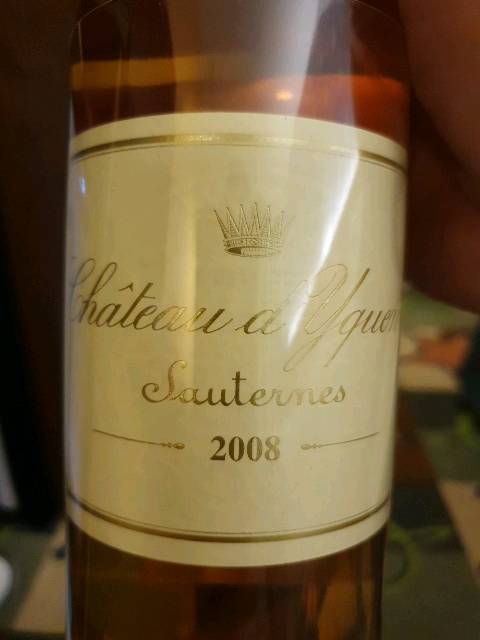
Château d'Yquem 2008
White (botrytized, Sauternes)France2008
By Daniel Min · Tasted 2019-12-01 · Published 2026-09-14 · Updated 2026-09-14
At a glance
Robert Parker (Wine Advocate) 96 · Lisa Perrotti-Brown (Wine Advocate) 95 · critics listed on Vivino: 94 ×3, plus 95 and 97 (re-tastings, 2009–2019)
Market note: As the only Sauternes château rated Premier Cru Supérieur in 1855, the Yquem name carries a built-in premium — its Vivino community average barely moves outside 4.6–4.8 regardless of vintage. The truly great years (2001, 1989, 1976, 1967, 1949, 1948, 1945) climb to 4.8–5.0.
What this wine is
In the 1855 Bordeaux classification, Yquem is the only château across all of Sauternes and Barsac ranked Premier Cru Supérieur — a tier above the First Growths. Jacques de Sauvage acquired the property in 1593; it passed to the Lur-Saluces family by marriage in 1785. In 1996, LVMH announced it would buy a 55% stake from the Lur-Saluces family for roughly $100 million. After a legal fight from Comte Alexandre de Lur-Saluces, the Bordeaux Court of Appeals confirmed LVMH's 38% acquisition in 1998, and LVMH has since taken full control and owns the estate to this day.
The heart of Yquem is Botrytis cinerea — noble rot. In Sauternes' particular microclimate, where humid morning mist gives way to afternoon sun, the fungus pierces the grape skins and evaporates their water, concentrating sugar, acid and aroma to an extreme. Because infection varies berry by berry, pickers make as many as six or seven passes through the vineyard by hand, selecting only the properly botrytized grapes — which drives the yield down to around 9 hectolitres per hectare, the basis for the phrase 'one glass of wine per vine.' A Sémillon-led blend with Sauvignon Blanc is aged roughly 20 months in new oak. In years that don't meet the estate's standard, no wine is bottled under the Château d'Yquem name at all — nine times in the 20th century (1910, 1915, 1930, 1951, 1952, 1964, 1972, 1974, 1992) and once in the 21st, in 2012.
What the world says
Robert Parker (Wine Advocate) gave the 2008 a 96 — "The palate is beautifully poised, tense and tightly coiled on the entry and then it just explodes in the mouth with pure, unbridled, joyous botrytized fruit." Lisa Perrotti-Brown followed with a 95 — "Rich, spicy and decadent in the mouth, with a racy backbone lifting the fruit, it finishes long and multilayered." Critic scores logged on Vivino, re-tasted several times between 2009 and 2019, range from 94 (three times) up to 95 and a high of 97.
Among the Vivino community's 1,608 ratings of the 2008, the average is 4.7, with 96.6% at 4 stars or above. The Yquem label is so consistently strong that the community average barely wavers outside 4.6–4.8 across vintages — the truly great years (2001, 1989, 1976, 1967, 1949, 1948, 1945) climb to 4.8–5.0. Honey dominates the keywords by far (1,977 mentions), followed by apricot (1,199), orange marmalade, pineapple, caramel and almond. Structure: sweetness 4.9, intensity 4.7, acidity 4.3 — an extreme sweetness held precisely in check by acid.
"80% Sémillon, 20% Sauvignon Blanc, botrytis. 20 months in new barrique. Wonderful on the nose: apricot, saffron, honey, wax, ash, caramel, vanilla, sweet spices. Excellent in the mouth too — soft and round, perfectly balanced with acidity." — Vivino review, Jan 2019, 5 stars
"Unctuous in the glass, liquid gold. The nose is simply fantastic — bright apricot coated in honey, freshly opened orange marmalade, luscious pressed peach." — Vivino review, Mar 2021, 4.8 stars
How I drank it
December 1, 2019, 4 stars. The note: "Honey, cedar, apricot, balanced."
That same night, I gave the Magnotta icewine an identical 4, and Duboeuf's Beaujolais-Villages Nouveau a 3. A year later, on November 11, 2020, I gave the 1988 vintage of Yquem a 5 — no note this time, but that was the evening I also drank Bollinger R.D. 2004, Kongsgaard's The Judge Chardonnay, and a Domaine Arnoux-Lachaux Vosne-Romanée, among others. Same château, a year apart, 4 and then 5: where the 2008 read as young and balanced — apricot, honey, cedar — the 1988, twelve years further along, earned a near-perfect score.
My 4 for the 2008 sits 0.7 below the Vivino community's 4.7 average for that vintage, and is more conservative than either Parker's 96 or Perrotti-Brown's 95. My 5 for the 1988, on the other hand, stood alongside the other high scores that same evening (Kongsgaard 4.5, Jadot's Corton-Charlemagne 4.5, Arnoux-Lachaux 5) as one of the top marks I gave that night.
Vivino community data
2008 vintage rating distribution (1608 ratings, average 4.7)
| 5★ | 854 (53%) | |
| 4★ | 701 (44%) | |
| 3★ | 38 (2%) | |
| 2★ | 9 (1%) | |
| 1★ | 6 (0%) |
Most-mentioned aromas
| Family | Mentions | Top keywords |
|---|---|---|
| Earth | 2765 | honey 1977 · minerals 130 · stone 130 · ginger 100 · honeycomb 84 |
| Stone fruit | 2501 | apricot 1199 · peach 595 · pear 206 · apple 154 · stone fruit 61 |
| Oak | 1833 | caramel 662 · vanilla 397 · oak 157 · toffee 116 · butter 111 |
| Citrus | 1521 | marmalade 383 · orange 376 · citrus 201 · orange peel 186 · lemon 142 |
| Tropical fruit | 1001 | pineapple 439 · tropical 274 · mango 159 · lychee 39 · passion fruit 36 |
| Non-oak | 650 | almond 183 · nutty 76 · marzipan 70 · hazelnut 62 · toast 49 |
| Dried fruit | 583 | dried apricot 274 · raisin 163 · dried fruit 53 · fig 39 · prune 25 |
Structure: Acidity 4.3/5 · Intensity 4.7/5 · Sweetness 4.9/5
Average by vintage (all vintages: 57720 ratings, average 4.7)
| Vintage | Average | Ratings |
|---|---|---|
| 2019 | 4.7 | 516 |
| 2018 | 4.7 | 468 |
| 2017 | 4.7 | 597 |
| 2016 | 4.7 | 1599 |
| 2015 | 4.7 | 1059 |
| 2014 | 4.7 | 806 |
| 2013 | 4.7 | 1040 |
| 2011 | 4.7 | 1182 |
| 2010 | 4.7 | 926 |
| 2009 | 4.7 | 931 |
| 2008 | 4.7 | 1608 |
| 2007 | 4.7 | 1354 |
| 2006 | 4.7 | 1469 |
| 2005 | 4.7 | 2537 |
| 2004 | 4.7 | 1207 |
| 2003 | 4.7 | 1844 |
| 2002 | 4.7 | 1321 |
| 2001 | 4.8 | 1765 |
| 1989 | 4.8 | 1352 |
| 1988 | 4.7 | 1284 |
My original note (Vivino, 2019-12-01)
“Honey, cedar, apricot, balanced”
Frequently asked questions
What kind of wine is Château d'Yquem?
A noble-rot wine from the only Sauternes château rated Premier Cru Supérieur in the 1855 classification. Hand-picked, botrytis-affected Sémillon and Sauvignon Blanc are aged roughly 20 months in new oak, famous for an extremely low yield of about 9 hectolitres per hectare. The 2008 vintage scored 96 from Parker and averages 4.7 on Vivino.
How much does it cost?
We haven't confirmed a world average price for this entry, so it's marked US$595 per 750ml ex-tax (Wine-Searcher, Sept 2026). As the pinnacle of Sauternes it's known to trade at a high price point in general, but no specific overseas retail figure was found.
What food pairs well with it?
Per Vivino data, it's a classic match with fruity desserts and blue cheese. It's also widely known as a pairing for foie gras.
Are there vintages where no wine was produced at all?
Yes. In years when the botrytis didn't develop properly or the harvest didn't meet the estate's standard, nothing was bottled under the Château d'Yquem name — nine times in the 20th century (1910, 1915, 1930, 1951, 1952, 1964, 1972, 1974, 1992) and once in the 21st, in 2012. Given how low the yield already is (one glass per vine), the estate has consistently chosen to skip a mediocre year rather than release it.