Home › Wine Notes › E. Guigal
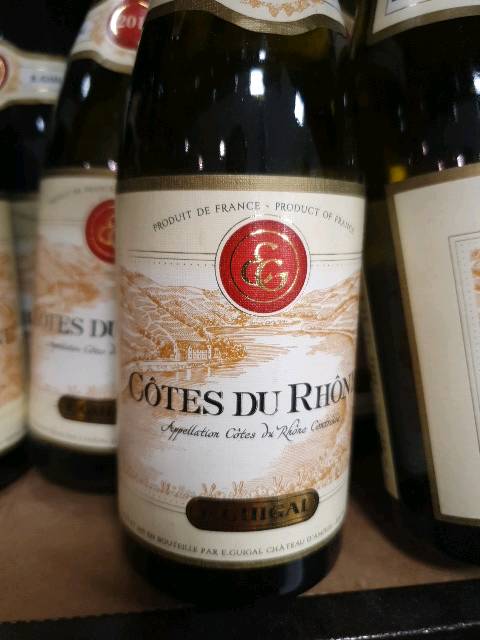
E. Guigal, Côtes-du-Rhône Blanc 2016
WhiteFrance2016
By Daniel Min · Tasted 2019-12-12 · Published 2026-09-15 · Updated 2026-09-15
At a glance
Four critic scores on file on Vivino — 91 (2014), 90 (Jan 2019), 89 (Dec 2017), 86 equivalent (Jan 2019); publications not named
Market note: Guigal's Côtes-du-Rhône range is a much cheaper entry point than the Northern Rhône single vineyards ("La La La"), but its sample size of 32,833 ratings is the second-largest of any wine covered in this magazine, after Krug Grande Cuvée. Vintage averages have stayed within 3.5–3.7 from 2000 through 2025 — remarkably consistent.
What this wine is
Étienne Guigal arrived in Ampuis, the heart of Côte-Rôtie, in 1924 at age fourteen, and spent fifteen years learning the trade at Vidal-Fleury. In 1946 he founded a house under his own name — he went on to make wine in Côte-Rôtie for 67 vintages, a lifetime spent on this same ground. In 1961, when his father temporarily lost his sight, his son Marcel Guigal took over management; his wife Bernadette joined in 1973 and the pair grew the business substantially — in the 1980s they acquired Vidal-Fleury, the very house where Étienne had once worked, and in 1995 they bought Château d'Ampuis. In 2007, third-generation Philippe Guigal formally joined as winemaker.
What made Guigal famous worldwide is the Côte-Rôtie single-vineyard trio nicknamed "La La La" — La Mouline, La Landonne and La Turque, named because all three end in the same syllable. By 2009 they had collected 21 perfect 100-point scores from Robert Parker, more than any other producer's single-vineyard wines. The 2003 vintage, released in 2007, set a pricing record at around $800 a bottle.
This Côtes-du-Rhône Blanc occupies an entirely different tier from the "La La La" wines. It's an entry-level white sourced from grapes across the Southern Rhône, built around 60% Viognier with small additions of Roussanne, Marsanne, Clairette, Bourboulenc and Grenache Blanc (per Guigal's own published blend). The house's underlying philosophy — putting the same care into its entry-level wines as its top cuvées — applies just as much here.
What the world says
The Vivino community rated this 2016 vintage 3.7 on average from 6,610 ratings — exactly matching the 3.7 average across the whole label's 32,833 ratings. That's the second-largest sample of any wine covered in this magazine, after Krug Grande Cuvée (39,670). The four critic scores on file cluster in the 86–91 range between 2014 and 2019.
The flavor keywords lead with the tree-fruit group of green apple, peach and pear (320 mentions), followed by citrus (214), the bread-and-nut group of brioche and toast (146), and yeast and cream (115). Structure: acidity 3.2/5, intensity 3.5 — a wine that shows Viognier's rich texture alongside a fairly gentle Southern Rhône acidity.
"Nice QPI from Guigal here, enjoy its peach punch. Nice floral start thanks to Viognier. Medium body that caresses the palate nicely with nectarine and peach flavors." — Vivino review, Apr 2019, 4.0 stars
"Pleasant and mild acidity. Not high acidity but it feels fresh. It has elegance. Slightly oak touching, acacia and melon. Nutty. I will choose again." — Vivino review, Jan 2022, 4.0 stars
Worth noting: the vintage averages have barely moved across 25 years, from 3.5 in 2000 to 3.7 in 2025 — evidence that Guigal has kept 'the same Guigal-ness, year after year' even in an entry-level white.
How I drank it
"Pale yellow. Peach, apricot, mineral, almond. Feel like good quality champagne. The gold shimmers so beautifully when you swirl it. The first impression is as fresh as putting a delicious champagne in your mouth. As it moves through, you feel soft minerals. Viognier seems tastiest when fresh — more floral, tropical, fresh character comes through." 12 December 2019, 4.0 stars.
That same day I gave André Perret's Condrieu 2014 a 3.5. Both wines put Viognier front and center, but the outcomes differed. The Condrieu was 100% Viognier, five or six years into bottle age, and even though my note that day argued Viognier 'should be drunk within 2–3 years,' I still gave it 3.5. This Guigal blend, by contrast, is only 60% Viognier and a much younger 2016 vintage — and still came out half a point higher at 4.0. The last line of my own note explains why: 'Viognier seems tastiest when fresh' turned into the actual score gap that same evening.
The 'like good quality champagne' comparison is interesting too. This is a still white, not a sparkling wine, but the fresh acidity and minerality apparently evoked Champagne for me. Set against the 5.0 I gave an actual Champagne, Krug Grande Cuvée, it's a clue to what I was chasing that night.
Vivino community data
2016 vintage rating distribution (6610 ratings, average 3.7)
| 5★ | 476 (7%) | |
| 4★ | 2716 (41%) | |
| 3★ | 3044 (46%) | |
| 2★ | 280 (4%) | |
| 1★ | 94 (1%) |
Most-mentioned aromas
| Family | Mentions | Top keywords |
|---|---|---|
| Stone fruit & apple | 320 | green apple 106 · apple 72 · peach 58 · pear 40 · yellow apple 13 |
| Citrus | 214 | citrus 106 · lemon 62 · lime 22 · grapefruit 13 |
| Bread & nuts (non-oak) | 146 | brioche 51 · toast 49 · almond 20 · biscuit 13 · nutty 6 |
| Yeast & cream | 115 | yeast 70 · cream 33 · cheese 6 |
| Earth | 61 | minerals 23 · honey 15 · stone 6 · smoke 4 · ginger 3 |
| Oak | 39 | butter 19 · vanilla 7 · pastry 4 · oak 3 · toffee 2 |
| Vegetal | 21 | straw 11 · hay 3 · chard 2 · grass 2 |
Structure: Acidity 3.2/5 · Intensity 3.5/5
Average by vintage (all vintages: 32833 ratings, average 3.7)
| Vintage | Average | Ratings |
|---|---|---|
| 2025 | 3.7 | 41 |
| 2024 | 3.7 | 214 |
| 2023 | 3.7 | 460 |
| 2022 | 3.7 | 829 |
| 2021 | 3.7 | 956 |
| 2020 | 3.7 | 759 |
| 2019 | 3.6 | 1570 |
| 2018 | 3.6 | 1195 |
| 2017 | 3.6 | 1896 |
| 2016 | 3.7 | 6610 |
| 2015 | 3.6 | 4673 |
| 2014 | 3.6 | 2307 |
| 2013 | 3.6 | 2227 |
| 2012 | 3.6 | 2923 |
| 2011 | 3.6 | 1556 |
| 2010 | 3.6 | 917 |
| 2009 | 3.5 | 396 |
| 2008 | 3.5 | 81 |
| 2007 | 3.6 | 236 |
| 2001 | 3.6 | 88 |
| 2000 | 3.5 | 114 |
My original note (Vivino, 2019-12-12)
“Pale yellow. Peach, apricot, mineral, almond. Feel like good quality champagne. 스월링시 반짝반짝 금빛이 너무 예쁩니다. 첫느낌은 맛있는 샴페인을 입에 넣듯이 산뜻합니다. 입으로 넘어가면 부드러운 미네랄이 느껴집니다. Viognier는 신선할때 floral, tropical, fresh 이 더 느껴져 맛있는것 같습니다.”
Frequently asked questions
What kind of wine is Guigal Côtes-du-Rhône Blanc 2016?
An entry-level white from the Guigal family (founded 1946), sourced from grapes across the Southern Rhône. Viognier forms the backbone with Roussanne, Marsanne and other varieties added. Vivino: 3.7 average from 6,610 ratings on this vintage; listed critic scores run 86–91.
How much does it cost?
World average price not yet confirmed for this piece (US$30 per 750ml ex-tax (Wine-Searcher, Aug 2026)). It sits far below Guigal's Côte-Rôtie single vineyards ("La La La") in price.
What food pairs well with it?
Vivino users suggest pork, poultry, rich fish (salmon, tuna), mature hard cheese, and cured meat.
What is "La La La"?
The nickname for Guigal's three Côte-Rôtie single-vineyard wines — La Mouline, La Landonne and La Turque, all ending in the same syllable. By 2009 they had earned 21 perfect 100-point scores from Robert Parker, more than any other producer's single vineyards — icon wines of the Rhône Valley, in an entirely different tier from this Côtes-du-Rhône Blanc.