Home › Wine Notes › Weingut Hanspeter Ziereisen
Weingut Ziereisen 'Rhini' 2019
RedGermany2019
By Daniel Min · Guide (not yet tasted) · Published 2026-09-09 · Updated 2026-09-09
At a glance
Falstaff gave this 2019 'Rhini' 94 points (Ulrich Sautter, tasted 2022 in the Spätburgunder Trophy Deutschland). wein.plus scored the same wine 88 (tasted 12 January 2022, drinking window 2023–2030+). I could not verify a Wine Advocate score for the 2019, but Stephan Reinhardt gave the same vineyard 94 points for the 2020 and 93 for the 2021 — the first year the wine was renamed from 'Rhini' to 'RH'. Lobenberg rated the 2017 Rhini 96–97, calling it "the style of a stylish Vosne-Romanée".
Market note: From the 2021 vintage Ziereisen renamed this wine from 'Rhini' to 'RH', so 2019 is among the last years to carry the original name on the label. US retailers mostly list it as sold out. Korean prices are not covered on this site.
What this wine is
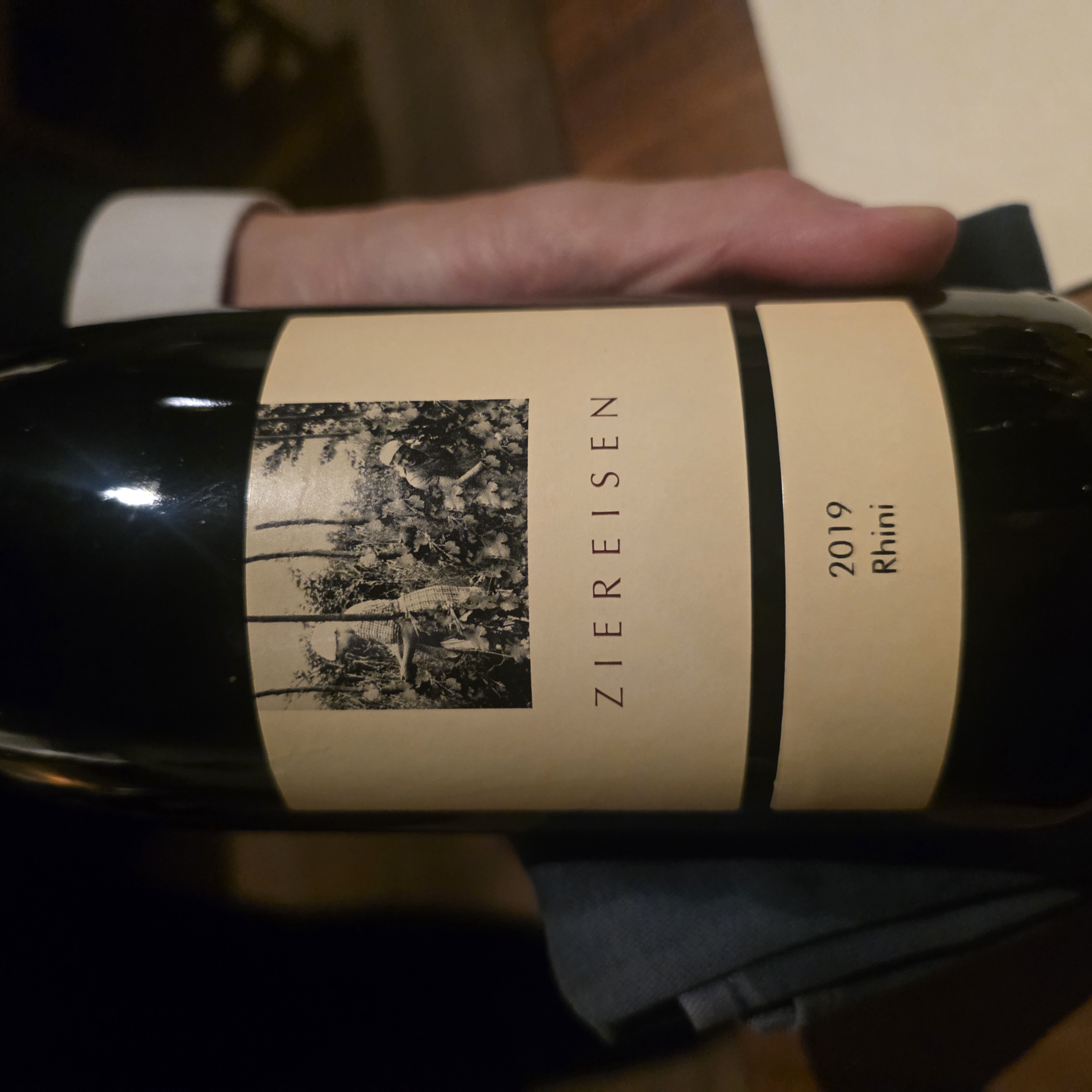
Start with what the label does not say. My bottle carries a black-and-white photograph, the word "ZIEREISEN", and "2019 Rhini". No grape, no classification. Ziereisen makes Spätburgunder, Grauburgunder, Gutedel, Chardonnay and Syrah, and names every cuvée after a vineyard, so what 'Rhini' actually is had to be checked rather than assumed.
The answer is unambiguous. Rhini is 100% Spätburgunder — Pinot Noir. Falstaff lists this vintage as "2019 »Rhini« Blauer Spätburgunder unfiltriert"; wein.plus files the same wine as "2019 Landwein 'Rhini' — Blauer Spätburgunder 100%". Vivino registers the grape as Pinot Noir and classifies the style as German Spätburgunder. Every German merchant sells it as "Blauer Spätburgunder Rhini". It is a red.
Rhini is not a grape name but a vineyard name. Ziereisen uses traditional field names — Steingrüble, Rhini, Schulen, Gestad — as cuvée names. Terry Theise calls Rhini "the best cadaster on the great hill" above the village. Lobenberg gives the most specific account: unlike Ziereisen's other sites, which lie on pure Jurassic limestone, Rhini has a loess-and-loam layer over the limestone, shot through with iron, at around 300 metres of elevation. The clones are half Burgundian and half Badisch, planted between 1988 and 2000. Wine Advocate's Stephan Reinhardt describes the same site as "a warmer plot with a large loamy layer topping the Oxfordian limestone."
The winemaking is stubborn. Rhini takes a higher share of whole clusters than the estate's other Pinots — though the picking team is trained to cut the stems at the right, lignified point, and Hanspeter refuses the practice of destemming and then adding selected stems back, which in his view bruises them into giving off green aromas. Fermentation is spontaneous, in a closed tank: he thinks the open maceration common in Germany releases aromas he dislikes, turning cherry into strawberry. Six weeks or so of maceration, then 20–22 months on the lees in 225-litre barriques (around 10% new, the rest used), bottled unfined and unfiltered. The label reads 13.5% alcohol, though Vivino's vintage record says 12.5% — the two figures disagree.
The real story here, though, is the classification. Ziereisen follows neither the Prädikat system of German wine law nor the VDP. Almost everything is bottled as Badischer Landwein — the lowest tier available. He gives up the right to state the vineyard as an official designation, and takes freedom from the rulebook instead. "Everything I do is forbidden," he told Theise. And this is the estate that Gault&Millau's German guide raised to its top rank, 'Weltklasse', five bunches, in the 2019 edition — one of only three in Baden. In 2015 his Gutedel '10 hoch 4' took a perfect 100 from the same guide; no Gutedel (Chasselas) had ever scored 100 before. Few estates carry such a gap between the tier printed on the bottle and the standing of the wine inside it.
Hanspeter Ziereisen was a carpenter. The family has been in Efringen-Kirchen since 1734, but what he inherited was a mixed farm built on asparagus, with half a hectare of vines. He turned to wine in 1991 and bottled his first vintage in 1993; with his wife Edeltraud — Edel — he has grown the estate to roughly 21 hectares. The casks come from the local Aßmann cooperage and run from 225 to 3,500 litres; reds get six to eight weeks of maceration and at least twenty months on the lees before unfiltered bottling. He describes what he makes this way: "We produce muscular wines. Not sumo wrestlers but decathletes."
The setting is the far south. Baden runs 500 kilometres along the Upper Rhine from Lake Constance to Heidelberg, the longest German region and, at 15,727 hectares, the third largest. More to the point, it is the only German region in EU wine zone B — the same zone as Champagne and Alsace. It gets 1,700–1,800 hours of sun a year and averages 10–11°C. Burgundy varieties make up 62% of plantings, with Spätburgunder alone at 32%, more than in any other German region. Markgräflerland is Baden's southernmost sub-region, running down to the Swiss border. Basel is half an hour from Efringen-Kirchen by car; across the Rhine to the west is Alsace.
2019 was a year of extremes across Germany. Frost in mid-May did patchy damage; June and July brought record heat (41.3°C in the Rheingau on 25 July). Rainfall in the Pfalz came in 50–60% below normal, and in the Ahr growers said they had never seen sunburn on that scale. August rain relieved the drought and cool September nights held the aromatics. Harvest ran from mid-September into early October, and the national crop of 8.4 million hectolitres was 4% under the ten-year average. Baden lost volume to drought and sunburn, but the German Wine Institute reported its young wines showing good fruit, with acidity described as moderate and often well below 2018. Jancis Robinson summed the vintage up as "exceptionally good — especially but not only in the Mosel and Nahe", and lighter and classier than 2018.
What the world says
The scores first. Falstaff gave this 2019 Rhini 94 points, tasted by Ulrich Sautter in the 2022 Spätburgunder Trophy Deutschland. His note: an initially reticent nose of elderberry, ripe dark cherry, hibiscus and garrigue that opens into real complexity; on the palate a lively acidity balancing fine notes of blackcurrant, cherry, violet and elderflower; good texture, still-young tannin, an attractive finish.
The second score is much tighter-fisted. wein.plus gave the same wine 88 (tasted 12 January 2022): "firm, fresh, quite polished aroma of ripe red and black berries with cherry, a hint of juniper, plus herbal, floral, peppery and very slightly meaty notes"; on the palate "taut, tangy, fresh fruit, noticeable acidity and present, youthful, fine tannin", with a drinking window of 2023–2030 and beyond. Six points apart — and yet the two notes describe the same wine. High acid, young tannin, not yet open. Read that state as potential and you get 94; read it as where the wine is today and you get 88.
I could not find a Wine Advocate score for the 2019. Stephan Reinhardt's numbers for the vintages either side of it are on record, though: 94 for the 2020 and 93 for the 2021. His 2021 note captures the wine's character well — "a tight, tart and refreshing, more masculine Pinot with generous fruit yet no signs of roundness or charm… saline and salivating on the finish… a long-distance runner to be aged for at least 4–5 years." Worth noting: from that 2021 vintage Ziereisen renamed the wine from 'Rhini' to 'RH'. The word on my bottle is among the last to carry the original name.
The community numbers are far cooler. On Vivino the 2019 averages 4.0 from 68 ratings, and the label as a whole 4.0 from 782. The distribution is unusual — not a single five. Forty-seven ratings in the fours, nineteen in the threes, one two and one one. That puts 69% at four or above, well below the 88% of the Pascal Cotat covered in the last piece. In Vivino's rankings it sits 23,283rd of 893,361 German wines, 1,875th of 99,548 in Baden and 764,171st of 12.35 million worldwide. Modest placings for a wine a critic scored 94. The structure figures suggest why.
Acidity 4.0/5, tannin 2.3/5, intensity 1.7/5, sweetness 1.5/5. That intensity is the lowest of any red covered in this magazine so far, and Vivino classifies the body as light. High acid, light frame, no sweetness. Open this expecting a dense, plush red and a three is the only score available to you. The keyword order points the same way: red fruit leads with 65 mentions (cherry 21, strawberry 11, raspberry 10), earth and minerals follow at 36 (minerals 9, mushroom 7, earthy 6, forest floor 4), oak third at 28. Black fruit is far down at 13.
"Pretty full-bodied for a Pinot, surprising amount of tannin. High acid. Dark red fruit driven, dominant cherry with subtle mushroom underneath." — Vivino review, Apr 2023, 4.0
"Bright and zippy, food friendly. Lots of cherry and well-integrated oak. Age hadn't tamed it as much as I thought it might — still needs time." — Vivino review, Nov 2025, 4.2
"Slightly cloudy, medium-depth ruby. Lots of red cherry and oak, some minerality, chalk notes. Musty but pleasant barnyard funk too. The finish reminds me of Gamay. Tannins are firm and grippy, very tight." — Vivino review, Aug 2024, 4.1
"Chewy, dusty Spätburgunder from pure limestone, high-altitude soils. Sour cherry, raspberry coulis, earthy." — Vivino review, Apr 2023, 3.8
The vintage curve moves in a narrow band between 3.9 and 4.2. The 2018 tops it at 4.2, as does 2013; 2017, 2015 and 2011 sit at 4.1; 2019, 2020 and 2012 at 4.0; 2016 and 2014 at 3.9. The 2019's 4.0 is squarely mid-table. Vivino's window runs 2022–2029, but Reinhardt and Lobenberg both talk in terms of at least four or five years and potentially fifteen or more. For food, Vivino users name beef, veal, poultry and game — deer and venison.
How I drank it
I have not opened this bottle. There is nothing I can honestly write about how it tastes. So instead, one fact from my log — the fact that is the reason I bought it.
I have 733 ratings on Vivino. Eighteen of them are German. I counted. France 392, Italy 92, the United States 86, Chile 28, Australia 24, Spain 23, New Zealand 21 — then Germany. And all eighteen are white. Riesling from the Mosel, Nahe, Rheingau and Rheinhessen; one Rheinhessen Chardonnay; two Beerenauslesen. Not one red. Over seven years — November 2019 to March 2026 — I opened German wine eighteen times and never once opened a red one.
The contrast sharpens when you look next door. In the same 733 there are 95 red Burgundies, and adding the Pinot Noirs from California, Oregon and Central Otago takes the Pinot-based reds past 110. The fives alone include Maison Leroy Bourgogne Rouge 2014, Maison Leroy Pommard 1er Cru 2002, Arnoux-Lachaux Vosne-Romanée 1er 'Aux Reignots' 2009, Lucien le Moine Chambolle-Musigny 1er 'Les Hauts Doix' 2016, Prieuré Roch 'Pinoterie' 2017, Dugat-Py Gevrey-Chambertin 'Les Evocelles' 2019, RAEN Royal St Robert 2017. Ninety-five red Burgundies, zero German Pinot. Same grape; cross one border and the record is simply empty. When this bottle is opened, that zero becomes a one.
Of the eighteen German entries, only five carry a note. I will quote only those.
Sybille Kuntz Riesling Spätlese Trocken 2014 — 24 March 2020, 4.0. The only bottle I opened that day. The note is long, and in Korean:
"minerals citrus lime petroleum pineapple stone lemon — at first German Riesling just felt normal to me overall, but taking my time with it, and especially with dessert at the end, I found a deeper flavour instead. Not the tropical quality and Sémillon character you get in a Chablis, of course :) but that depth coming and going is what gives Sybille Kuntz that light-but-not-light feeling of Riesling. I ended up drinking it from a Champagne flute, and with the tall bottle shape it felt like happily drinking a German beer :)"
"At first it just felt normal" — and then time changed it. "Light but not light." That is the longest thing I have ever written about a German wine, and reading it again in front of this bottle is strange. A wine with acidity at 4.0/5 and intensity at 1.7/5. A wine a critic scored 94 and the community never once gave a five. Whether "light but not light" fits this Spätburgunder as neatly as it fitted that Riesling is the thing I most want to find out before I open it. For the record, that Kuntz 2014 averages 4.1 from 64 ratings on Vivino; my 4.0 is 0.1 below the crowd.
Franzen Bremmer Calmont Riesling 2016 — 27 June 2020, 4.0. Again the only bottle that day.
"citrus lemon minerals honey stone slate — Riesling is so good in summer :) my wife always says the long Riesling bottle shape is pretty :) tasty~~"
Both notes mention the bottle. In one I am drinking from a flute and thinking about the tall bottle; in the other my wife is admiring its shape. The recurring impression German wine has left in my log is not aroma or structure but the shape of the bottle — which, honestly, is evidence of how little I have dug into this country. That Franzen 2016 averages 4.1 from 168 ratings; my 4.0 is again 0.1 below.
Leonard Kreusch Beerenauslese 2015 — 22 November 2019, 4.5 and the 2014 — 15 December 2019, 4.5, both with English notes. On the 2015: "Gasoline, fruity, honey, lychee, ripe peach, golden colour." On the 2014: "Beautiful gold. Perfect dessert wine for me, like a light beverage. Gasoline, honey, good acidity close to your eyes, peach, fruity." Two vintages of the same wine three weeks apart, both at 4.5. My highest German scores sit here and with two Dönnhoffs.
For the rest, without notes, only the numbers. Dönnhoff Niederhäuser Hermannshöhle Riesling Auslese Goldkapsel 2018 — 28 June 2020, 4.5 (no note), the day after the Franzen. Vivino gives that wine 4.3 from 79 ratings, so my 4.5 is 0.2 above — one of the rare times I marked a German wine more generously than the crowd. Elsewhere: Dönnhoff Kreuznacher Krötenpfuhl Kabinett 2018 at 4.5; Gunderloch Rothenberg Spätlese 2016, Nik Weis St. Urbans-Hof 2020, Thörle Chardonnay 2022 and Markus Molitor Niedermenniger Herrenberg Spätlese 2003 all at 4.0.
And then there is 26 April 2021. That day I opened three Mosel Rieslings side by side and gave all three a 3.0 — Van Volxem Saar Riesling 2018, Schloss Lieser SL Riesling Trocken 2016, Karl Erbes Ürziger Würzgarten Spätlese 2017. No notes on any of them. Across all eighteen the average is 3.75: four 4.5s, seven 4.0s, one 3.5, six 3.0s. I have been hard on German wine.
So this is a guide written before the tasting, not after it. What I have settled in advance: with intensity at 1.7/5 and acidity at 4.0/5, this is not the place to expect grand cru Burgundy weight. Unfined and unfiltered, so there may be sediment; Austrian tasters recommend decanting hours ahead. The food will come from the Vivino list — beef, veal, poultry, game. And one more thing. The label says this wine is Landwein, the bottom rung of the German ladder, and Falstaff gave it 94 points. What sits between those two numbers is exactly what I want to find in the first German red I will ever have opened.
The score goes in on the day I drink it.
Vivino community data
2019 vintage rating distribution (68 ratings, average 4.0)
| 5★ | 0 (0%) | |
| 4★ | 47 (69%) | |
| 3★ | 19 (28%) | |
| 2★ | 1 (1%) | |
| 1★ | 1 (1%) |
Most-mentioned aromas
| Family | Mentions | Top keywords |
|---|---|---|
| Red fruit | 65 | cherry 21 · strawberry 11 · raspberry 10 · red cherry 8 · red fruit 7 |
| Earth & minerals | 36 | minerals 9 · mushroom 7 · earthy 6 · forest floor 4 · chalk 2 |
| Oak | 28 | oak 18 · vanilla 3 · chocolate 2 · allspice 1 · cedar 1 |
| Spices | 18 | pepper 9 · cinnamon 4 · green herbs 1 · licorice 1 · rosemary 1 |
| Black fruit | 13 | plum 4 · black fruit 3 · black cherry 2 · blackcurrant 1 · blueberry 1 |
| Ferment & dairy | 4 | banana 2 · cream 2 |
| Dried fruit | 1 | raisin 1 |
Structure: Acidity 4.0/5 · Intensity 1.7/5 · Tannin 2.3/5 · Sweetness 1.5/5
Average by vintage (all vintages: 782 ratings, average 4.0)
| Vintage | Average | Ratings |
|---|---|---|
| 2020 | 4.0 | 51 |
| 2019 | 4.0 | 68 |
| 2018 | 4.2 | 51 |
| 2017 | 4.1 | 88 |
| 2016 | 3.9 | 65 |
| 2015 | 4.1 | 60 |
| 2014 | 3.9 | 67 |
| 2013 | 4.2 | 58 |
| 2012 | 4.0 | 66 |
| 2011 | 4.1 | 36 |
My record
I have not tasted this one myself yet. It is one of the most searched-for wines, so the research came first; my score and note will be added here the day I open a bottle.
Frequently asked questions
What is Ziereisen 'Rhini' 2019?
A 100% Spätburgunder (Pinot Noir) red from Efringen-Kirchen in Markgräflerland, Baden. Falstaff, wein.plus and Vivino all register the grape as Pinot Noir, and every German merchant sells it as 'Blauer Spätburgunder Rhini'. Rhini is a vineyard, not a grape: a parcel at around 300 metres above the village, with an iron-rich loess and loam layer over limestone. Higher whole-cluster share than the estate's other Pinots, spontaneous fermentation in a closed tank, roughly six weeks of maceration, 20–22 months on the lees in barrique, bottled unfined and unfiltered. The label reads 13.5% alcohol. Falstaff 94, wein.plus 88, Vivino 4.0 from 68 ratings.
How much does it cost?
German retail for the 2019 is €34 a 750ml bottle (Weinhandel Fertsch and unserweinladen, and the same €34 listed by wein.plus, checked September 2026). Falstaff shows the wine's price band as €20–50. I could not find the 2019 at US retail; neighbouring vintages list at US$69.99 (Perrine's, 2020), US$65.99 (Flatiron Wines, New York, 2020, sold out) and US$41.94 (SaratogaWine, 2021). The Wine-Searcher world average returned a 403 again and could not be verified. Korean prices are not covered on this site.
What food goes with it?
Vivino users name beef, veal, poultry and game — deer and venison. But the structure here is intensity 1.7/5, acidity 4.0/5, tannin 2.3/5: light-framed and high in acid. That points to roast chicken, duck, mushroom dishes and red-fleshed fish rather than a steak under a heavy sauce. The wine is unfined and unfiltered, so expect possible sediment, and enough tasters call it closed in youth that decanting several hours ahead is the standard advice.
Why does one of Germany's best estates print the lowest classification on its label?
Because Hanspeter Ziereisen chooses to. He follows neither the Prädikat system of German wine law nor the VDP's vineyard hierarchy, and bottles almost everything as Badischer Landwein. He gives up the right to state an official vineyard designation and takes freedom from the rulebook in exchange, keeping the traditional field names — Steingrüble, Rhini, Schulen, Gestad — on the label anyway. Gault&Millau's German guide nevertheless raised the estate to its top 'Weltklasse' rank in the 2019 edition, one of only three in Baden, and in 2015 gave his Gutedel '10 hoch 4' a perfect 100 — the first Gutedel (Chasselas) ever to score 100. Few estates carry such a gap between the tier on the bottle and the standing of the wine inside it.
Links & sources
View on Vivino · Prices on Wine-Searcher
- Vivino — wine page and community data (2019 vintage)
- Falstaff — 2019 »Rhini« Blauer Spätburgunder unfiltriert (94 points, Ulrich Sautter, 2022)
- wein.plus — 2019 Landwein 'Rhini' (100% Blauer Spätburgunder, 88 points, 13.5%, €34)
- Lobenbergs Gute Weine — Blauer Spätburgunder Rhini (the Rhini site's soil, clones and vinification; 96–97 for the 2017)
- Terry Theise — Weingut Ziereisen (the Landwein philosophy, the Rhini site)
- German Wine USA — Whose Wine is it Anyway? Meet Hanspeter and Edel Ziereisen (1991 start, 21 hectares, Aßmann casks, winemaking)
- Grape Guru — Weingut Ziereisen / Baden (Gault&Millau 100 points and 'Weltklasse' rank; Baden statistics)
- GermanWineEstates — Vintage 2019 (the 2019 German growing season)
- Skurnik Wines — Spätburgunder 'Rhini', Ziereisen (Wine Advocate 93 for the 2021; vinification detail)
- Weinhandel Fertsch — Blauer Spätburgunder Rhini 2019 Ziereisen (€34, 13.5%, barrique with ~10% new oak)