Home › Wine Notes › Domaine Pascal Cotat
Pascal Cotat Sancerre 'Les Monts Damnés' 2022
WhiteFrance2022
By Daniel Min · Guide (not yet tasted) · Published 2026-09-09 · Updated 2026-09-09
At a glance
I could not verify a score for this vintage from Wine Advocate, Vinous, Jancis Robinson or Decanter, and Vivino's registered-critic field is empty. Importer material quotes Robert Parker calling the Cotat family's Sauvignon Blancs "among the finest Sauvignon Blancs I have ever put to my lips", but that is not a vintage score.
Market note: Production is tiny — Pascal's entire holding is 2.3–2.5 hectares — so critics rarely see the wine at all, and most US retailers list it as sold out. For reference, his cousin François Cotat's wine from the same vineyard trades higher.
What this wine is
The upper Loire, Sancerre AOC — and within it a small village called Chavignol. Sancerre is famous for Sauvignon Blanc, but it has no system for classifying individual vineyards. Even so, everyone here treats Les Monts Damnés as a de facto grand cru. Decanter calls it "the unofficial cru of Sancerre."
The name catches the eye first: Les Monts Damnés means "the damned hills." There are several accounts of the etymology, but the one most often repeated is the simplest — the slope is so steep that working it is hell. According to Decanter the incline reaches 45 degrees, the aspect is south to south-southeast, and the whole site covers about 35 hectares, split between growers into Burgundian-sized fragments. The soil is Kimmeridgian marl: Jurassic limestone laid down 151–157 million years ago, studded with fossil oyster shells, the same family of rock that runs under Chablis. Locally it is called terres blanches, white earth. Clay content runs high, between 35% and 65%, and that smectite clay swells in rain and then releases water slowly during drought — which is why the vines here do not shrivel in a hot year. Gérard Boulay, François and Pascal Cotat, Didier Dagueneau, Henri Bourgeois and Vincent Delaporte all hold parcels on this hill.
The Cotats were the second generation to bottle in Chavignol. The brothers Paul and Francis Cotat took over their uncle Ferdinand's vines and began in 1947, working one cellar and making one cuvée per wine, which then went out under two different labels. That arrangement ended in 1998. As John Gilman tells it, the French tax authorities objected to two labels emerging from a single cellar, and the cousins François and Pascal divided the vineyards into separate estates. François kept the old cellars and 4 hectares (3.5 of Sauvignon Blanc, 0.5 of Pinot Noir); Pascal took parcels in Monts Damnés and La Grande Côte and released his first vintage in 1999. So: François Cotat and Pascal Cotat are cousins, the vineyards were once one holding, and today they are unambiguously two different domaines. Similar names, different wines — do not conflate them.
Pascal farms something between 2.3 and 2.5 hectares, with vines averaging around forty years. The farming is described as organic in practice though not certified. The winemaking is simple to the point of stubbornness: hand harvest, whole-cluster pressing, indigenous yeasts, more than a year in old demi-muids and large tonneaux, bottled without fining or filtration. He picks weeks later than the regional average, which in some years leaves a little residual sugar — the classic Cotat off-dry register. How far outside convention this house sits is best shown by his cousin's record: François' wines were denied the Sancerre appellation in 1998 and 2002 for having too much residual sugar. Merchants agree on the arc of Pascal's wines: closed in youth, showing little more than almond, lemon and hawthorn, opening after two or three years and running on into honey and tertiary character over fifteen to twenty-five.
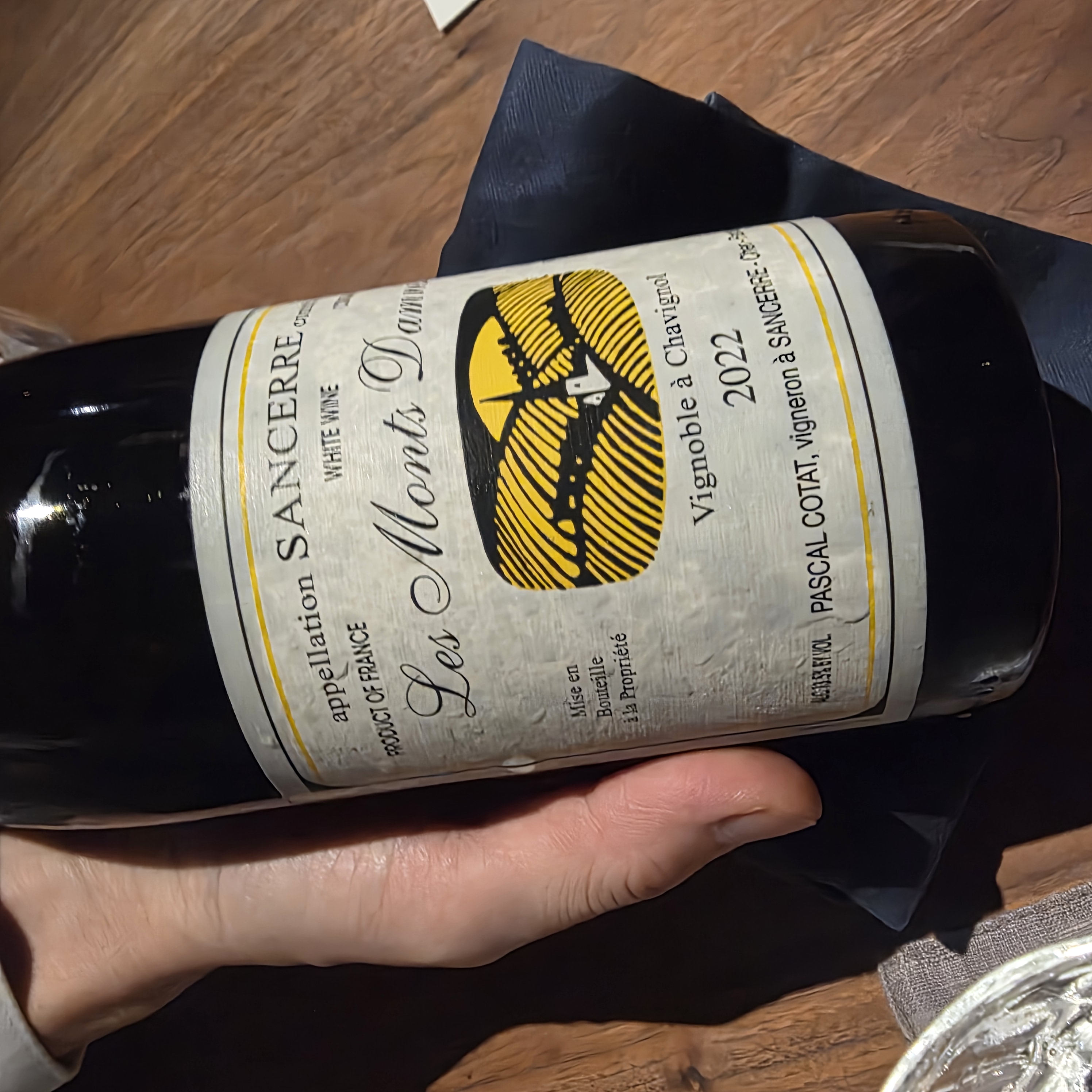
My bottle's label reads "appellation SANCERRE contrôlée / WHITE WINE / Les Monts Damnés / Mise en Bouteille à la Propriété / Vignoble à Chavignol / 2022 / PASCAL COTAT, vigneron à SANCERRE - Cher / ALC 13.5% BY VOL". Estate-bottled, Chavignol fruit, 13.5% alcohol — and Vivino's registered wine facts give the same 13.5%.
2022 was hot in the Loire. Heat and drought ran through the summer, and August rain was what saved the vintage. Early April frost did almost no damage because budbreak was late. The Ban de Vendanges fell on 23 August, exceptionally early. Decanter's 2022 Loire whites report gave the year a full five out of five while noting that the Sauvignon Blancs have enough acidity but "naturally less marked than the 2021 vintage." Drought cut yields, and the fruit ripened towards grapefruit, pineapple and stone fruit.
What the world says
An honest admission first: I could find no critic score for this wine. Not in Wine Advocate, not in Vinous, not in Jancis Robinson, not in Decanter — no number attached to Pascal Cotat Monts Damnés 2022 anywhere I could verify. Vivino's registered-critic field is empty too. A line from Robert Parker calling this family's wines "among the finest Sauvignon Blancs I have ever put to my lips" circulates in importer material, but that is not a vintage score. It also tells you something: the production is so small that the wine rarely reaches a critic's table. This wine's reputation travels on the name of the vineyard and the name of the domaine, not on points.
The numbers that do exist are the community's. On Vivino the 2022 averages 4.3 from 138 ratings — not a thick sample, so it is worth looking at the label as a whole: 3,764 ratings across all vintages, averaging 4.2. The 2022's distribution is 14 fives, 107 in the fours, 17 in the threes, and not a single rating at two or below. That puts 88% at four or above. In Vivino's rankings it sits 18,077th of 3.37 million French wines, 76,975th of 12.35 million worldwide, and 217th of 52,283 in Sancerre. It is not a Mouton-scale label, but that places it inside the top 0.4% of its region.
The structure figures summarise the wine well: acidity 4.0/5, intensity 2.3/5, sweetness 1.6/5. That acidity is the highest of any white covered in this magazine so far, and the intensity is low. This is a wine that holds itself up with acid, not with weight. The keyword order is the interesting part. The leading group is not fruit but earth and minerals — minerals 87, honey 56, flint 28, stone 21, chalk 11. Citrus comes second (citrus 61, grapefruit 40, lemon 34), orchard fruit third (pear 24, apple 23, melon 20). The grass, gooseberry and cat's-pee register that people associate with Sauvignon Blanc sits far down the list at 50 mentions. Which is why it is hard to believe this and a Marlborough Sauvignon are the same grape. The recommended window is 2023–2027, though merchants and reviewers talk in terms of a decade or more.
"I had no idea Sancerre Sauvignon Blanc could be this good. Pale gold. A thirst-inducing grapefruit aroma, then white peach. Two hours of air brought seashells, jasmine tea, honeysuckle, mango and graphite." — Vivino review, Apr 2025, 4.3
"A wonderful Sauvignon Blanc from Sancerre — the best I have drunk, with a personality both original and easy to like. Pure perfume of its calcareous terroir." — Vivino review, Mar 2026, 4.5
"Nose of wet stones, Meyer lemon and light tropical fruit. Pale colour. The palate is lemon, some grapefruit and gravelly minerality at medium intensity. One of my favourite Sancerres, from one of my favourite producers." — Vivino review, Apr 2025, 4.4
"Minerals, citrus, honey, grapefruit, lemon, cream, apple. Ah, this is good. Subtle and soft." — Vivino review, Aug 2025, 4.3
Across the vintage curve this label moves between 4.1 and 4.4. The 2022's 4.3 sits in the upper half, just under the 2023 (4.4 from 106 ratings), with 2020, 2019, 2018, 2017 and 2016 lined up at 4.2. The only year to fall below four is 2008, at 3.9. The merchant descriptions broadly agree with one another: thin topsoil straight onto chalk bedrock, melon and fresh herbs and white flowers, a saline edge, a texture that is creamy and light at once, lime zest and grapefruit on a long finish. For food, Vivino users name pork, shellfish, vegetarian dishes, spicy food — and goat's cheese.
How I drank it
I have not opened this bottle. There is nothing I can honestly write about how it tastes. So instead I will write about the Sancerre that is already in my log.
I have 733 ratings on Vivino. Two of them are Sancerre. I counted. In a list where Burgundy and Bordeaux run to dozens of bottles each, two Sancerres means I have essentially never drunk this region.
- Lucien Crochet, Sancerre Blanc 2017 — 11 February 2021, 4.0 (no note)
- Henri Bourgeois, Sancerre Les Baronnes Blanc 2019 — 12 April 2021, 3.0 (no note)
I left no note on either. So I do not know what I thought that evening any more than you do. What survives is the date, the score and the line-up around it.
11 February 2021 was a big table — eighteen bottles. It was the night I gave Domaine Leflaive Puligny-Montrachet 1er Cru 'Clavoillon' 2017 a five, Egly-Ouriet Brut Tradition a five, Taittinger Comtes de Champagne Rosé 2006 a five, and Arnaud Ente Meursault 2017 a 4.5. In that company the Crochet Sancerre got a 4.0. Not the top score of the night, but a four among top-flight white Burgundy and grower Champagne.
12 April 2021 was a different kind of evening. Eight of the ten bottles were white: Château Fuissé Pouilly-Fuissé Le Clos 2018 (4.0), William Fèvre Chablis 2018 (3.0), Louis Latour Pouilly-Fuissé 2018 (3.0), Mud House Sauvignon Blanc 2020 (3.0). A comparative white tasting, in other words. The Henri Bourgeois Les Baronnes got a 3.0, in the same cluster as the Chablis and the Marlborough Sauvignon. The high score that night went to Sine Qua Non 'Entre Chien et Loup' 2015 (5.0).
Set the numbers side by side. On Vivino, Lucien Crochet Sancerre Blanc 2017 averages 4.2 from 617 ratings (4.1 from 6,370 across the label). My 4.0 is 0.2 below the community. Henri Bourgeois Les Baronnes 2019 averages 4.1 from 2,372 ratings (4.0 from 17,228 across the label). My 3.0 is 1.1 below. I marked both harder than the crowd, and the second one considerably harder.
Which is the reason I bought this bottle. Crochet and Bourgeois are Sancerre's solid, large producers — Bourgeois alone carries more than 17,000 Vivino ratings on that label, Crochet more than 6,000. Pascal Cotat's Monts Damnés has 3,764 across every vintage, and 138 on the 2022. His entire holding is 2.3 to 2.5 hectares. That is not a difference of scale; it is a difference of tier. The two bottles I scored a 3 and a 4 are what Sancerre reliably makes. This one is what Sancerre makes by exception.
So this is a guide written before the tasting, not after it. Things I have checked in advance: merchants recommend serving at 13°C. Since the wine is neither fined nor filtered there may be sediment, and enough reviewers describe it as closed in youth that I plan to open it an hour or two ahead. The food is already decided — Crottin de Chavignol, the goat's cheese that took its AOC in 1976 and comes from the very village these vines sit above. Cheese and wine off the same soil, the textbook local pairing; goat's cheese is on the Vivino food list for this wine too, and baked crottin on a green salad is the classic form.
The score goes in on the day I drink it. Whether the third Sancerre in a log of 733 lands above the first two, I will find out then.
Vivino community data
2022 vintage rating distribution (138 ratings, average 4.3)
| 5★ | 14 (10%) | |
| 4★ | 107 (78%) | |
| 3★ | 17 (12%) | |
| 2★ | 0 (0%) | |
| 1★ | 0 (0%) |
Most-mentioned aromas
| Family | Mentions | Top keywords |
|---|---|---|
| Earth & minerals | 256 | minerals 87 · honey 56 · flint 28 · stone 21 · chalk 11 |
| Citrus | 181 | citrus 61 · grapefruit 40 · lemon 34 · lime 18 · lemon zest 8 |
| Orchard fruit | 133 | pear 24 · apple 23 · melon 20 · peach 17 · green apple 16 |
| Tropical fruit | 61 | tropical 22 · pineapple 19 · guava 4 · mango 4 · lychee 3 |
| Vegetal | 50 | grass 16 · gooseberry 14 · straw 7 · hay 6 · cat's pee 2 |
| Ferment & dairy | 47 | cream 26 · oil 8 · banana 3 · cheese 2 · bread yeast 1 |
| Oak | 42 | oak 23 · butter 8 · vanilla 6 · pastry 2 · butterscotch 1 |
Structure: Acidity 4.0/5 · Intensity 2.3/5 · Sweetness 1.6/5
Average by vintage (all vintages: 3764 ratings, average 4.2)
| Vintage | Average | Ratings |
|---|---|---|
| 2023 | 4.4 | 106 |
| 2022 | 4.3 | 138 |
| 2021 | 4.3 | 105 |
| 2020 | 4.2 | 204 |
| 2019 | 4.2 | 210 |
| 2018 | 4.2 | 231 |
| 2017 | 4.2 | 295 |
| 2016 | 4.2 | 258 |
| 2015 | 4.3 | 329 |
| 2014 | 4.1 | 256 |
| 2013 | 4.2 | 330 |
| 2012 | 4.1 | 263 |
| 2011 | 4.1 | 220 |
| 2010 | 4.3 | 182 |
| 2009 | 4.2 | 118 |
| 2008 | 3.9 | 87 |
| 2007 | 4.2 | 62 |
| 2005 | 4.2 | 53 |
| 2004 | 4.2 | 30 |
My record
I have not tasted this one myself yet. It is one of the most searched-for wines, so the research came first; my score and note will be added here the day I open a bottle.
Frequently asked questions
What is Pascal Cotat Sancerre 'Les Monts Damnés' 2022?
A 100% Sauvignon Blanc white from Chavignol, in Sancerre on France's upper Loire. Les Monts Damnés is a south-facing slope reaching 45 degrees on Kimmeridgian marl (terres blanches), treated as Sancerre's unofficial grand cru. Hand-harvested, fermented with indigenous yeasts, aged over a year in old demi-muids, bottled unfined and unfiltered. The label reads 13.5% alcohol. Vivino 4.3 from 138 ratings, 4.2 from 3,764 across the label; no score from the major critics could be verified.
How much does it cost?
At overseas retail: US$119.99 at 67 Wine in New York, US$124.99 at wine.com (sold out), and €65 including tax (€54.17 ex-tax) at Clos des Millésimes in France, all checked in September 2026. iDealwine estimates the market price of the 2023 vintage at €63 a bottle, up 23.5% year on year. The Wine-Searcher world average returned a 403 this time and could not be verified. Korean prices are not covered on this site.
What food goes with it?
The textbook answer is Crottin de Chavignol — the goat's cheese that took its AOC in 1976 and comes from the same village as these vines. Cheese and wine from the same soil; baked crottin on a green salad is the classic form. Vivino users also name pork, shellfish, vegetarian dishes and spicy food. With acidity at 4.0/5 and intensity at just 2.3/5, this suits oysters and clams, raw fish, and goat's or sheep's milk cheese far better than anything under a heavy sauce. Merchants recommend serving at 13°C.
How are Pascal Cotat and François Cotat different?
They are cousins, and their estates are the two halves of one domaine split in 1998. From 1947 the brothers Paul and Francis Cotat worked a single cellar, made one cuvée per wine and put it out under two labels; the French tax authorities objected to that arrangement, and the vineyards were divided. François kept the old cellars and 4 hectares (3.5 of Sauvignon Blanc, 0.5 of Pinot Noir); Pascal took parcels in Monts Damnés and La Grande Côte and made his first vintage in 1999. They are separate domaines today, with separate labels. This bottle is Pascal's.
Links & sources
View on Vivino · Prices on Wine-Searcher
- Vivino — wine page and community data (2022 vintage)
- Decanter — Exploring Les Monts Damnés: the unofficial 'cru' of Sancerre (slope, area, Kimmeridgian marl)
- John Gilman, View From The Cellar (reprinted by North Berkeley Imports) — the Cotat domaine's history and the 1998 division
- North Berkeley Imports — Domaine Pascal Cotat, Sancerre 'Les Monts Damnés' technical sheet (indigenous yeast, demi-muids, unfined and unfiltered)
- Decanter — Loire whites 2022 plus top new releases (2022 growing season)
- Wikipedia — Crottin de Chavignol (AOC 1976)