Home › Wine Notes › Leonard Kreusch
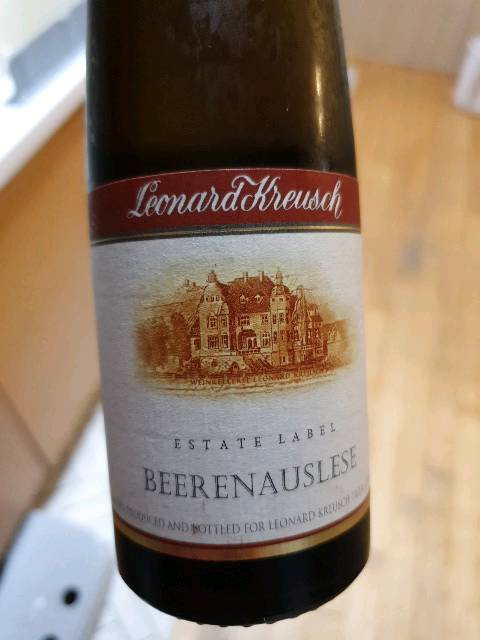
Leonard Kreusch, Beerenauslese 2014
White (sweet)Germany2014
By Daniel Min · Tasted 2019-12-15 · Published 2026-09-14 · Updated 2026-09-14
At a glance
No confirmed reviews for the 2014/2015 vintages. Wine Enthusiast reviewed the 2018 vintage of the same label (a different year), but that score doesn't apply here.
Market note: Price confirmation pending (not listed on Wine-Searcher (no average as of Sept 2026)). The 2014 vintage has only 7 Vivino ratings, too small a sample for Vivino to publish an average (the figures above are for the whole label, 50 ratings). Leonard Kreusch began in 1897 on the Mosel and set up a US export company in 1950; it's now a fourth-generation family-run German export house.
What this wine is
Leonard Kreusch was founded in 1897 by 27-year-old Leonard Kreusch on the Mosel. After Prohibition ended, the family focused on the US export market, setting up Leonard Kreusch, Inc. in New Jersey in 1950 as sole importer and distributor, and running headquarters since 1949 out of a former sparkling-wine facility in Trier on the Mosel. Now in its fourth generation, it has grown into a large export brand covering not just the Mosel but Rheinhessen and other German and European regions.
Beerenauslese (BA) sits on Germany's Prädikatswein ladder above Auslese and below Trockenbeerenauslese (TBA). It requires individually picked, overripe, often botrytis-affected berries that clear a minimum must-weight (Öchsle) threshold. This bottle's grape is Huxelrebe — a crossing of Gutedel and Courtillier Musqué bred by Georg Scheu in 1927, prized in Germany for accumulating sugar quickly and taking botrytis well, which makes it a common choice for Auslese- and BA-level sweet wines. It is not Riesling.
What the world says
Across the whole label, Vivino carries 50 ratings averaging 4.1. The 2014 vintage alone has only 7 ratings — too small a sample for Vivino to show a separate average (that handful splits 1 at 3 stars, 4 at 4 stars, 2 at 5 stars). No critic score is confirmed. The flavor keywords are mostly stone fruit — peach, apple, apricot (25 mentions) — and a honey-led earth group (19, including one mention of petroleum), with some lychee-driven tropical notes (6).
One review stands out: "I thought it was Riesling, but Hook Celeb!?" — a startled note from someone who, like me, assumed Riesling. 'Gasoline' is usually associated with TDN (1,1,6-trimethyl-1,2-dihydronaphthalene), the compound behind aged Riesling's signature petrol note — but since this wine is Huxelrebe, that specific association doesn't strictly hold. Similar aroma precursors can occur in other varieties too, so the exact chemistry behind the gasoline note here isn't something I can state with certainty.
How I drank it
I've had this label twice.
November 22, 2019, 2015 vintage, 4.5 stars: "Gasoline, fruity, honey, lychee, ripe peach, golden color." The same day I logged Avignonesi 50 & 50 at 4.0 and San Leonardo at 3.0 — both also in this magazine.
December 15, 2019, 2014 vintage, 4.5 stars: "Beautiful gold. Perfect desert wine for me like light beverage. Gasoline, honey, good acidity close to your eyes, peach, fruity."
Different vintages, same 4.5 score, and the same core keywords — gasoline, honey, peach, gold — repeating almost word for word. That reads less like coincidence and more like a genuinely consistent house style. Vivino's suggested drinking window for this wine is 2018–2034, so both tastings fell near the start of the window.
Vivino community data
2014 vintage rating distribution (50 ratings, average 4.1)
| 5★ | 2 (29%) | |
| 4★ | 4 (57%) | |
| 3★ | 1 (14%) | |
| 2★ | 0 (0%) | |
| 1★ | 0 (0%) |
Most-mentioned aromas
| Family | Mentions | Top keywords |
|---|---|---|
| Stone fruit | 25 | peach 9 · apple 7 · apricot 5 · nectarine 2 · melon 1 |
| Earth | 19 | honey 14 · ginger 2 · beeswax 1 · petroleum 1 · wax 1 |
| Citrus | 11 | lemon 4 · marmalade 2 · orange 2 · citrus 1 · grapefruit 1 |
| Tropical fruit | 6 | lychee 4 · pineapple 1 · tropical 1 |
Structure:
Average by vintage (all vintages: 50 ratings, average 4.1)
| Vintage | Average | Ratings |
|---|
My original note (Vivino, 2019-12-15)
“Beautiful gold. Perfect desert wine for me like light beverage. Gasoline, honey, good acidity close to your eyes, peach, fruity.”
Frequently asked questions
What kind of wine is Leonard Kreusch's Beerenauslese?
A botrytis-affected sweet white from Leonard Kreusch, a large German export house based in the Rheinhessen line. The grape is Huxelrebe, not Riesling, at 9.5% alcohol. Expect gasoline, honey, peach and lychee; Vivino's whole-label average is 4.1 (50 ratings).
How much does it cost?
Price confirmation pending (not listed on Wine-Searcher (no average as of Sept 2026)).
What food pairs with it?
No food pairing data is listed on Vivino. Beerenauslese-level sweet wines are typically served with blue cheese or fruit-based desserts.
What does the Beerenauslese (BA) designation mean?
It's a rung on Germany's Prädikatswein ladder, above Auslese and below Trockenbeerenauslese (TBA). It requires individually picked, overripe, often botrytis-affected berries that clear a minimum must-weight threshold — low-yield, intensely sweet dessert wine.