Home › Wine Notes › Bodegas Hijos de Juan Gil
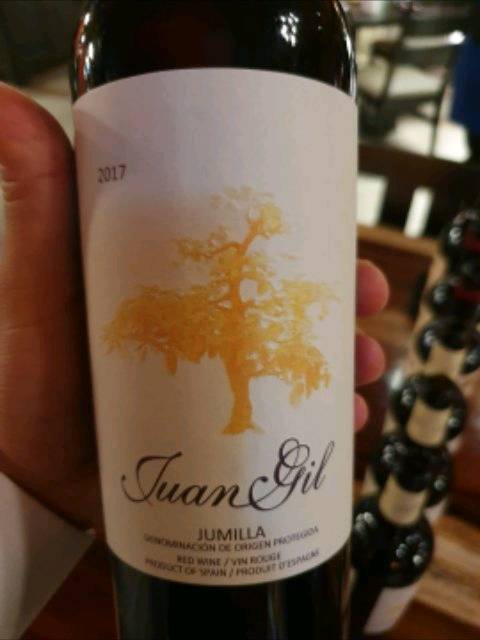
Juan Gil Blue Label '18 Meses' Jumilla 2017
RedSpain2017
By Daniel Min · Tasted 2019-11-13 · Published 2026-09-08 · Updated 2026-09-08
At a glance
Wine Spectator 94 · Wine Advocate (Luis Gutiérrez) 91 · critics listed on Vivino 95 (Oct 2019) and 93·93 (Mar 2020) · CellarTracker 91.3
Market note: The Juan Gil range runs Silver (12 months) < Blue (18 months) < El Nido. Blue Label is Jumilla's flagship, scoring in the low-to-mid 90s from Spectator every year; the 2019 and 2020 vintages peak at 4.3 on Vivino.
What this wine is
Jumilla is a dry plateau in south-eastern Spain, between Alicante and Murcia. It barely rains, summers reach 40°C, and because phylloxera largely passed it by in the late 19th century, ungrafted old Monastrell (France's Mourvèdre) vines still survive there. For a long time it was bulk-wine country, and the family that changed that is the Gils. Bodegas Juan Gil was founded in 1916 by Juan Gil Giménez; in 2002 fourth-generation Miguel Gil built a new winery, teamed up with Australian winemaker Chris Ringland and launched 'El Nido', lifting Jumilla into Parker-90s territory. Today, as Gil Family Estates, the family runs around ten wineries across Spain.
Blue Label is the middle tier of the house, sitting between the Silver Label (100% Monastrell, 12 months) and El Nido (Monastrell and Cabernet, Parker 95-ish). Old-vine Monastrell (60%) from limestone soils at around 700 m elevation is joined by 30% Cabernet Sauvignon and 10% Syrah, each variety aged separately for 18 months in French and American oak before blending. That is why the Spanish label reads '18 Meses' (18 months). Alcohol is 15.5%. The producer's note: "Purple-black. Toasted bread, graphite, earth, spice box, black fruit, a touch of balsamic. Dense, savoury flavours and a long, pure finish."
What the world says
Wine Spectator gave the 2017 94 points — "A muscular red. Savoury earth, black tea and tobacco wrap a rich core." Luis Gutiérrez of the Wine Advocate gave it 91 — "A wine for those who like ripe, dense, oaky reds. A sweet sensation on the finish, chocolate and cocoa powder." Two reviews looking at one wine from precisely two directions: Spectator sees the power, the Advocate sees the sweetness and the oak.
The Vivino community of 2,380 averages 4.2, with 87% at 4 or above — the highest community score of any wine covered in this magazine so far, apart from Almaviva (4.5). The keywords run oak, vanilla, chocolate, tobacco and coffee; blackberry, plum and blueberry; leather, earth, smoke and balsamic; pepper and licorice — and prune, raisin and fig (81 mentions) stand out. This is the aroma of a hot region, where the fruit goes past ripe into slightly dried. Structure: intensity 4.0/5, tannin 3.3, sweetness 2.0.
The vintages have not wavered from 4.2–4.3 since 2014.
"Dense, full-bodied blend. Blackcurrant and berries, balsamic, wood, tobacco. Concentrated, juicy and long. A winner. WS 94." — Vivino review, Feb 2021, 4.5 stars
"Surprisingly good. Thick texture, lots of oak, dried fig, balsamic. Round on the palate, long tannic finish." — Vivino review, Oct 2020, 4.5 stars
"A lot to unpack. Clove, tobacco, a little vanilla, blueberry. Spicy black fruit. Really opened up after about an hour." — Vivino review, Apr 2020, 4.5 stars
How I drank it
November 13, 2019, 3 stars. "Not bad."
Of all the wines I have written up for this magazine, this is the one where my score and the community's diverge the most. Community 4.2, Spectator 94, me 3. I gave Almaviva 4.5 the same day, so it is not that my palate could not handle a dense red. So why?
Looking at the data now, the answer is obvious. This is a 15.5% wine that spent 18 months in oak, and review after review repeats 'it opened up after an hour'. The me of November 2019 did not decant. I would have pulled the cork and poured straight away, and what comes out at that moment is only the heat of the alcohol and the sweetness of the oak. The earth, black tea and tobacco that Spectator describes sit behind that. On top of which, Almaviva was sitting next to it. Beside the tidy pepper of Chile's finest Cabernet, Jumilla's hot, sweet fruit would have felt coarse. The 3 stars are less a score for the wine than a score for how I treated it that night.
So this bottle goes to the top of my re-taste list, on three conditions: at least an hour of decanting, on its own without an Almaviva beside it, and with food that can carry its weight — lamb chops or smoked barbecue. Dismissing a wine that 87% of the community rates 4 or higher with a single line, 'Not bad', is a poor showing for someone keeping records. That said, at ₩70,000–90,000 (about US$51–65) the Korean price is more than double the overseas one, so it may be wiser to warm up with the Silver Label (around ₩40,000, about US$29) first.
Vivino community data
2017 vintage rating distribution (2380 ratings, average 4.2)
| 5★ | 443 (19%) | |
| 4★ | 1618 (68%) | |
| 3★ | 269 (11%) | |
| 2★ | 30 (1%) | |
| 1★ | 20 (1%) |
Most-mentioned aromas
| Family | Mentions | Top keywords |
|---|---|---|
| Oak | 1465 | oak 463 · vanilla 327 · chocolate 229 · tobacco 120 · coffee 69 |
| Black fruit | 997 | blackberry 277 · plum 203 · blueberry 83 |
| Earth & leather | 509 | leather 167 · earth 104 · smoke 89 · balsamic 44 |
| Red fruit | 288 | cherry 160 · raspberry 30 |
| Spice | 286 | pepper 102 · licorice 76 · cinnamon 26 · mint 22 |
| Dried fruit | 81 | prune 28 · raisin 26 · fig 20 |
Structure: Acidity 3.2/5 · Intensity 4.0/5 · Tannin 3.3/5 · Sweetness 2.0/5
Average by vintage (all vintages: 28455 ratings, average 4.2)
| Vintage | Average | Ratings |
|---|---|---|
| 2012 | 3.9 | 2111 |
| 2013 | 4.0 | 1370 |
| 2014 | 4.2 | 1562 |
| 2015 | 4.2 | 2326 |
| 2016 | 4.2 | 3122 |
| 2017 | 4.2 | 2380 |
| 2018 | 4.2 | 2840 |
| 2019 | 4.3 | 3103 |
| 2020 | 4.3 | 2377 |
| 2021 | 4.2 | 1364 |
| 2022 | 4.3 | 1270 |
My original note (Vivino, 2019-11-13)
“Not bad.”
Buying in Korea
Frequently asked questions
What kind of wine is Juan Gil Blue Label?
A full-bodied red from Bodegas Juan Gil in Jumilla, Spain. Old-vine Monastrell (60%) blended with 30% Cabernet Sauvignon and 10% Syrah, aged 18 months in French and American oak (the '18 Meses' on the label). 15.5% alcohol, a dense, sweet-edged style of blackberry, chocolate, vanilla and licorice; Wine Spectator 94, Vivino 4.2.
What is the difference between Silver Label, Blue Label and El Nido?
Silver (12 Meses) is 100% Monastrell aged 12 months, around ₩40,000 (about US$29); Blue (18 Meses) is the Cabernet–Syrah blend aged 18 months; El Nido is the top label made with Chris Ringland, scoring around Parker 95. Blue is generally considered the best critic score for the money.
How much does it cost?
Korean retail ₩73,000–89,000 (Vinobot, August 2026, about US$53–64). Overseas retail is US$30–35, so Korea is more than twice the price. In Korea the Silver Label is far more common and cheaper.
Does it need decanting?
Yes. At 15.5% alcohol with 18 months of oak, opened and poured straight away it shows only alcohol and oak. Vivino reviews repeat 'it opened up after an hour'. Decant for at least an hour and serve slightly cool at 16–18°C. Suggested drinking window: 2022–2027.